Beat Diaspora: Beats, Buses, Bricks

an omnivorous take on music of the beat-based variety and the urban spaces that nurture it

Wednesday, October 29, 2008

Non-Alignment Pact


Buried in the international section of the Inqy I saw a small story on Rwanda and their decision to stop teaching French in favor of English in the nation's schools (syndicated from the WaPo, of course, in this era of shrinking newsrooms). The article is mostly blase, operating on the assumption of French's diminishing role in the world. In particular, it prints a horrendous quote by Theoneste Mutsindashyaka, Rwanda's state minister for education: "When you look at the French-speaking countries - it's really just France, and a small part of Belgium and a small part of Switzerland."

Tell that to the Organisation internationale de la francophonie (Fr only, natch) and its claim of 200 million French speakers on five continents. I guess the minister never took a look at this map. Across the pond, The Guardian dug a little deeper, pulling a better quote from Vincent Karenga, the Trade and Industry Minister: "French is spoken only in France, some parts of west Africa, parts of Canada and Switzerland." Still off-base -- he didn't even mention Belgium, the very reason French is spoken in Rwanda -- but at least he got West Africa, a massive stronghold of French and the very reason French will remain a major language over the coming decades.

Of course, the article appropriately links the decision to lingering anger at the French for their role in the Rwandan genocide and a wider post-colonial push away from European powers, especially former colonizer francophone Belgium. But as an assiduous observer of French as a language of resistance in the Americas, from Louisiana to the Caribbean to Québec, I'm sorry to hear it couldn't occupy a more positive role in Rwanda. Its role in Africa is more as a common thread across countries filled with hundreds of local languages. That, in part, has rendered Dakar such a hub for African hip-hop -- a swirl of languages with French usually running through.

I wonder how politics will trickle down to affect culture vis-à-vis Rwandan hip-hop. The excellent Africanhiphop.com points to an excited local scene with the usual hybrid of languages (Swahili, the local Kinyarwanda, French, and English). Several profiles point to French-language schools that rappers attdended as children. But as that shifts in the coming generation, it's only logical that French will fall by the wayside, and by extension the tour dates to France and Canada will be replaced by the UK and the U.S.


Labels: , , ,

Wednesday, July 09, 2008

Neg Fondamental


The death of Aimé Césaire back in April passed through with minimal fanfare in the U.S., whereas the French broadcast his funeral live on television. As a poet, politician, and philosopher, he stands immensely tall in 20th century discourse yet hails from a comparatively small place: the island of Martinique. A former French colony and now fully-fledged department (formerly DOM, département d’outre-mer or overseas department, and now a DFA, départment française d’Amérique), Martinique has produced a remarkable number of noteworthy French writers in the last 60 years. Start with Frantz Fanon, then Césaire, then more contemporary authors Edouard Glissant, Patrick Chamoiseau, Raphael Confiant, and Suzanne Dracius. It’s an impressive litany of forceful francophone writers from the colonial and post-colonial eras who have dredged their island’s history and its subordinate status to France to make powerful statements about the legacy of slavery, the effects of colonialism, the cultural bonds of the Caribbean, and the global black experience.

Césaire is, as he called himself, “nègre fondamental” (black at the core). The translation is tricky on both fronts. “Nègre” is a stronger term than “noir,” and has carried a derogatory connotation dating back to plantation slavery. It can still be used as an insult, but it isn’t nearly as ugly as English’s own six-letter word. While the hip-hop world has reclaimed that term to the Nth degree, I couldn’t imagine MLK or Malcolm X getting behind it. “Nègre” is something both rappers and writers use. “Fondamental” can be fundamental or foundational, both of which are applicable here. Rather than pick one and exclude the other, I like the notion of “at the core” as covering both the essence quality of “fundamental” and the building block notion of “foundational.”

In Martinique, where he was mayor of the capital, Fort-de-France, for an astonishing 56 years (1945-2001) and deputy to the French national assembly for another 48 (1945-1993), Césaire was the grand homme of the island. While his early days, especially his break with the French communist party in order to found the Parti Progressiste Martiniquais, made for contentious politics, he simply became more revered the more he aged. Supposedly he held court in a square near city hall up until even a year or two ago. It was my surprise to learn he was still alive when I first discovered him back in high school, by which time he was already in his 80s.

While his voice was assured as early as 1939 with the publication of his epic poem Cahier d'un retour au pays natal (Notebook of a return to my native land), he lived long enough to be criticized. A younger generation of French Caribbean writers saw Négritude and its emphasis on Africa as undermining the uniqueness of Caribbean heritage, which they lauded as créolité (Creoleness). It was a healthy debate, though, and especially upon his death there was universal reverence. Patrick Chamoiseau, himself a founder of the créolité movement, wrote a stirring memoriam (Fr only). Politically, a half-century can surely get corrupt, and the night clerk at my hotel told me he was accused of letting henchmen run the show as he got increasingly old and incapable of managing all the details of mayoralty by himself.

But the signs -- literal billboards, posters, and public displays across the island -- of appreciation for Césaire were ubiquitous across Martinique, beginning the moment you stepped into the airport, even before passport control. The airport, I should add, is incongruously named after Césaire, something he wasn't exactly in favor of. Sarkozy, then Minister of the Interior, pushed it through -- two years after Césaire refused to meet him in Fort-de-France for his support of a bill acknowledging the "positive effects" of colonialism.

My stay in Martinique was short, just long enough to give the island a quick pass, stock up on some Antillean books (including teach yourself Creole!) and CDs (francophone dancehall and zouk galore) although I hope to return one day for a longer research effort. But it was enough to recognize the richness -- cultural, intellectual, literary -- of this particular corner of the francophone Caribbean.

I'm currently reading Chamoiseau's Texaco, which tells the story of a shantytown on the outskirts of Fort-de-France (built on the remnants of a Texaco facility) as it faces demolition at the hands of the city's urban reform efforts. In this neighborhood founded by rural exodus, Creole is at its strongest, yet it is here that I found the "Merci Aimé Césaire" graffiti, the largest I saw on the island, written in French but signed with a Creole name. Here that Chamoiseau eulogizes 200 years of Martinique history as they have resulted in the establishment of Texaco but thanks Serge Letchimy, urbanist and now mayor of Fort-de-France, who led the effort to raze the shantytown. The novel won the Prix Goncourt, France's equivalent of a Pulitzer, catapaulting Chamoiseau, Martinique, and Texaco to fame.

Even après-Césaire, Martinique -- and by extension the French Caribbean (most notably Guadeloupe) -- are poised to remain a hotbed of literary and intellectual activity. If anything, the outpouring from Martinique's younger luminaries simply confirms the multi-generational strain is alive and well.

[My own merci to Mylène Priam for her wonderful teaching on francophone literature in the Caribbean. She spoke about her work here, which garnered a bit of blog press in the Caribbean-academico-sphere.]

Labels: , , , , , , ,

Saturday, May 03, 2008

Blaze Habs Blaze

A cold spring weekend up north drives away all thoughts of baseball. Instead, my mind turns to Lord Stanley's Cup. Hockey is the sport I grew up with, and I relish it all the more for its current underdog status on the American sporting scene. As a francophile (and more of francophonie than of France), hockey makes me all the more fond of Québec, and Montréal in particular. The Habs (short for Habitants, we were here first) -- né Canadiens -- are easily the most storied professional team in North America. And when their fans belt out the bilingual "O Canada" at home on a nationally televised game, there's an audible flash of French broadcast across North America, a rare enough occurrence.

But it's do or die for les Glorieux tonight against the reincarnation of the Broad Street Bullies. The Habs barely made it past the Boston Bruins in game 7 -- the two teams having duked it out more than any other pair in North American sports.

They've got some encouragement on the beat front of course. I've slept a little on mon pôte Ghislain Poirier's No Ground Under, especially the video for it's lead single, "Blazin." Chunky bass meets ice hockey and transnational migration, what more could I ask for?! Does kreyol have a word for puck yet?


Maybe the B's got the last laugh, though:
Ghislain Poirier - Blazin (DJ C Remix).

And don't miss the Québécois rework of Flo-Rida's "Low" en français!


Here's hoping that they'll still be chanting "Go Habs Go" after tonight and the Montréalais will crank out a few more re-edits for the great white dirty north.

Labels: , , , , ,

Thursday, April 10, 2008

Bayou Country


"The Acadians are perhaps America's most enigmatic people, equally misunderstood by outsiders and members of the group itself. The shroud of misunderstanding is the legacy of the group's unique North American experience, the co-optation of its leadership element by the regional socioeconomic elites, and the creatin and persistence of conflicting (uncomplimentary and complimentary) stereotypes by generations of popular American writers, journalists, and filmmakers. These arbiters of America's popular perceptions have generally visited the bayou country too briefly to acquire accurate impressions of the area and its inhabitants, and their depictions of Cajuns constantly reinforce the existing popular misconceptions about Acadiana."

--Carl A. Brrasseaux, French, Cajun, Creole, Houma: A Primer on Francophone Louisiana

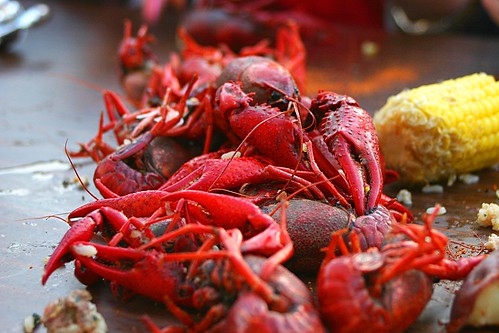
With only a night and a day spent in bayou country, I can point the same finger squarely at myself. I'll resist too many interpretive moves, then, to simply express my amazement at discovering firsthand an oft-forgotten (and -neglected) corner of francophone America: There are 250,000 French speakers still inhabitating Louisana, especially in the southeastern and southwestern parishes.


The vast majority, of course, are Acadians / Cajuns, who ended up in Louisiana centuries ago after getting expelled from Nova Scotia. The first group of Europeans to establish a North American identity, they fiercely resisted assimilation up until the 20th century -- French was banned in Louisiana schools and the invasion of English TV really led to a decline in French proficiency. Cajuns were maligned as rednecks and the backwater of Louisiana.

I stayed in a B&B run by a couple who were the first in each of their families to speak English. We chatted in French over pain perdu in the morning, and surprisingly I found the accent easier to understand than Québécois French. The new generation of Cajuns is speaking a whole mix of accents thanks to CODOFIL, which promotes the French language in all its forms (even Creole!) in the state, and has brought in French teachers from Quebec, France, the Caribbean, and French Africa. Bilingualism can work in the Union, it seems, as long as it's not Spanish.


But the Cajun French persists. A Catholic priest compiled a dictionary of the predominately oral language in the '80s and there is a burgeoning Cajun literary scene. At a bookstore specializing in Louisiana French literature I picked up an autobiography by Jeanne Castille, a militant supporter of French in the mid-20th century, and an anthology of new Cajun fiction.


While I had to indulge my literary side, the oral tradition means music is never far behind. The Jean Lafitte Wetlands Acadian Cultural Center had an extremely well-articulated & well-curated section on music, arguing for cross-pollination between Cajuns and the various Africans and Europeans they came into contact with -- ultimately producing Cajun music on the one hand, and Zydeco on the other.


Get your accordion fix and take a listen for yourself --

Jambalaya - Bon Whisky
(from Cajun Saturday Night!)

Zydeco All-Stars - Hot Steppin' Zydeco
(from Ultimate Zydeco)

Labels: , , ,

Sunday, February 25, 2007

beat research: the francophone connection


french electro, banlieue hip-hop, parisian disco, maghrebi raï, african rap, antillean jazz, and found sounds from anywhere else the French military surrendered.

Beat Research @ The Enormous Room
Monday, February 26
9 pm - 1 am


Labels: , ,

Thursday, January 25, 2007

The Francophone Connection, Bmore Edition

french electro, banlieue hip-hop, parisian disco, maghrebi raï, african rap, antillean jazz, and found sounds from anywhere else the French military surrendered.

If you can't read the fine print, it's:
TaxLo @ Sonar
407 E. Saratoga St. Baltimore, MD
Friday January 26, 9 pm - 2 am

expect more on the modern tick to keep the cool kids happy, but I may slip a biguine track or two in.

Labels: ,

Friday, July 14, 2006

Tying up loose ends: St. Martin FM


Almost two weeks into my stay in Rio & have plenty to say, but before I do, I want to make some brief comments on where I was before coming down to Brasil: St-Martin/Sint Maarten. It's more or less your typical Caribbean holiday destination, with an economy dependent on (and currently thriving on) tourism, as it's far too small to have much in the way of industry or natural resources. As such, it's also too small to have many of the same social problems that plague the likes of Haiti, Cuba, and Jamaica. It may be apocryphal, but I've always been under the impression that the island has 100% employment (at the very least, while some residents are poor, there is nothing I've ever seen in the way of grinding poverty or homelessness).

It's one somewhat interesting claim to fame, however, is that it's the smallest island in the world to be partitioned between two nations. In this case, the Dutch and the French.

The distinction isn't massively important -- the border doesn't consist of much more than a sign (see above), a la crossing a state line, and on an island of this size you're likely to cross it several times a day. However, such proximity does sharply contrast the cultural differences between the two.

The French side is actual French soil, as the commune de St-Martin is part of the departement d'outre mer of Guadeloupe. They use the euro, they're EU citizens, they vote in French elections. In short, the exact same political rights and privileges as someone living in Paris. Consequently, the ever-cushy French welfare state takes care of St-Martin pretty well, such that it's not over-developed, maintains some architectural consistency, and is generally a little slice of Gallic paradise in the Caribbean (the food can't be beat). Again, too small to produce the firebrands of francophone thought along the lines of Aime Cesaire, Frantz Fanon, or Maryse Conde. [which certainly make Martinique and Guadeloupe far more interesting places in a world-historical sense, but this is family vacation and besides, I didn't have much of a say.]

If the French use the long arm of the government to keep things, well, French, then the Dutch, as expected, do the exact opposite: they let capitalism run wild. Part of the Netherlands Antilles (hope you can read Dutch), Sint-Maarten still uses the Antillean guilder of all bizarre currencies, although the entire island never turns down the Yankee dollar. More autonomous than the French commune, the NA's eyes are clearly flush with dollar signs and in the last several years development has been occurring at a breakneck pace (although at least one voice is suggesting some restraint). Between the cruise ship hordes descending upon Philipsburg's duty-free stores to rape and pillage with their Visas to the glitz of casinos, the Dutch side has always had a certain middlebrow air.

Maybe it's the boom of the last couple years or maybe I've just wised up to it after visiting for so many years, but the Dutch side of the island is becoming an ersatz Vegas. Its status as a shopping and gambling mecca is joined by a further injection of Americana courtesy of the excessive strip mall that now characterizes the first couple miles in either direction of the airport, populated by the likes of Ric's Place and Soprano's Piano Bar (I'm sure a few HBO execs wouldn't be pleased by that wholesale logo appropriation).

American hegemony, cultural and otherwise, in the Caribbean has been SOP since at least the Monroe Doctrine, but it's still a marvel (and not necessarily a good one) to watch a place slowly turned into an American middlebrow theme park. [as urban critic Dave Hickey argues, Vegas is the vast, green middle of the American self.]

Moreover, as I can't help but notice, this dialectic also plays out musically. Rental cars are the best way to get around, and while I'll confess that I did bring an iPod/tape adapter on occasion, I've had years to get acquainted with the radio band down there. The Dutch side's strongest signal, Laser 101, follows its nose up north to come up with a top 10 that's probably cribbed straight from last month's charts on Hot 97 with a token rock track thrown in (this year it's the Chili Peppers).

French radio, however, offers an interesting pastiche. Between St-Martin's chief broadcaster, Radio Calypso, and neighboring St-Barthelemy's Radio St-Barth, the listener shuttles between the region's chief cultural hegemons. Sure, the U.S. looms large and there's always a pop hit or two that's played several times a day (in this case Shakira & Wyclef's "Hips Don't Lie", whose Caribbean tint I'm sure doesn't hurt its reception; I realize a Colombian and a Haitian do not an American make, but in production and marketing they sure do). They jostle alongside the latest from France -- usually a mix of ballads and house tracks (Bob Sinclair's "World Hold On" was unstoppable) -- and then choice Anglo-American house from the last couple of years. [with the French holding the house banner so high, you'd think "acieeeeeeeeed" was first yelled with a French accent] Last year's house-remix-of-classic-rock format is still popular, and I heard plenty of 2005 faves Max Graham vs. Yes - "Owner of a Lonely Heart" and Deep Dish ft. Stevie Nicks - "Dreams" (the latter made for a perfect 6 am closer to a dawn drive home and according to my brother, Stevie re-recordedcorded the lyrics in the studio where the original Fleetwood Mac song was cut). Finally, Jamaica can't be left out: Vybz Kartel's "Rich Rich Rich" was definitely the dancehall song I head the most over the airwaves.

Reggaeton, as the current musique du plume of the Caribbean, was largely absent from the FM dial, although that's not a total mystery given the lack of Spanish-speaking islands in the immediate vicinity. There were some car soundsystems pumping CDs (as evidenced by the occasional skipping track) on a Sunday at Mullet Bay, although eventually some jerk had to overpower it with what I think was soca (sorry, but I'll take snares over brass any day).

As a final note, I'm focusing so much on the radio because if there's a local music scene in St. Martin, I utterly failed to come across it (and in truth didn't look very hard in the first place). My brother and his wife, on the other hand, who made friends with an incredibly friendly security guard at the island's mega-club (a little present of some hard to find NBA gear goes along way; Gilbert Arenas, bringing people together), got invited to the Bad Boy Party on the day that I left. Apparently held in the heart of Philipsburg, it was a local soundsystem featuring dancehall and reggaeton MCs. He reports that it was top-notch with pumping 15-ft speakers and a one-story stack of mids and subs. Friendly enough that they earned a "Shout out to my white boy and his blond girl chillin' in the place." It's refreshing to hear that even in the depths of Philipsburg, there's still enough local creativity to resist the complete Vegasification of "the Friendly Island."

Labels: , , ,