Beat Diaspora: Beats, Buses, Bricks

an omnivorous take on music of the beat-based variety and the urban spaces that nurture it

Sunday, January 14, 2007

93 Hardcore, East Side: clichy-s/s-bois


Like Magellan, I didn't quite succeed in my attempt at circumnavigation. Fortunately, unlike him, I came out alive. Although we both shared some transportation issues. Granted I got a late start, and granted it was Sunday, but intra-banlieue transportation in Île-de-France is painfully slow, which is easily its own strike against the state's urbanism: in Paris proper, one is never more than 1/2 kilometer from a métro station. The density obviously justifies the extensiveness of the métro network, but it just about dead stops outside of the city limits, with only a few lines reaching into the suburbs. And in contrast, the buses and tramways are much slower and much less frequent. But that's out of kilter in a metropolitan region where the city proper is more than four times smaller in population than its environs.

There is the RER, or commuter rail, which plays its own questionable role in the relationship between Paris and the banlieue -- Les Halles, where four of the five lines converge, resembles an immigration checkpoint as much as a subway stop, as police and RATP security are always out in force, checking for tickets and then checking your papers if you look North African . . . they were practically corralling non-whites on New Year's Eve when the métro ran all night.

But I made it out eventually, arriving at Clichy-sous-Bois, infamous flashpoint of last years "évenements" (commemorated in the graffiti at the top). It's a bleak place for sure, big concrete tower after big concrete tower.


This is one of the nicer looking ones, as I ran out of camera battery before I got to the peeling paint, dilapidated exteriors, barren yards. But no matter the outside aesthetics -- or interior, for that matter, I can recall reading a few articles that point out they're just normal looking apartments inside -- it's mostly a matter of location.
I saw what an ordeal it is just to get to/from Paris, where the bulk of any potential job opportunities would be (most of the cités were built to house factory workers during the post-war industrial boom, which now post-post-war is post-industrial with no more factories). And of course, as this sign indicates, by car is probably the best way to go -- not always the most affordable means of transit.

As the other direction points to, of course, there's a town nearby. Each of the communes (municipalities, essentially) of the banlieue that are now known for their cités began simply as small villages on the outskirts of Paris. While I didn't make it to Clichy-sous-Bois's centre ville, I passed through adjacent Livry-Gargan.


It was Sunday market day, a scene that could have been lifted from any side street in Paris. To that extent, I think the Banlieue 13 vision is unfairly dystopian. There are more than just housing projects surrounding the city. Saint-Denis, for example, is home to the stunning Basilique de Saint-Denis, royal necropolis since the 12th century (a more worthwhile visit than Notre Dame). The towns proper sometimes live in tension with the cités that started cropping up 50 years ago, but there's enough pride in them that they'll retain their identity.

Vis-à-vis the cités, I wrote in my somewhat hasty (and uninformed) banlieue commentary about the lack of pride or ownership in the communities. It's still a largely valid point -- litter everywhere, for example, and hardly a Rio-style residents' association in sight. They just seem to suffer from neglect, plain and simple.


Kids making a soccer field out of whatever flat patch of dirt they can find, burned out wreckage of exactly what I don't know. A lot of loitering, lingering, killing time. A few folks fixing cars, some teens pumping some bass out of a stereo in a parking lot. Someone blew by on a 4x4, getting his thrills however he could. Pure anomie.

Like the Soviet housing blocs I visited in Berlin (as always, blog post TBA), there's nothing you can do about housing projects once they're already there. It's a not a configuration conducive to mixed-use -- the best East Berlin's Marzahn neighborhood could muster was a shopping mall (the commercial counterpart of a housing project, I guess), the best Clichy-sous-Bois could offer was a McDonald's and a few scattered municipal services (elementary & middle school, firehouse).


The département (Seine-Saint-Denis, postal code 93), for its part, tries to build up some sense of civic engagement with its own reformulation of the Republic's "liberté, égalité, fraternité." Most noticeably, it addresses the New Year's well-wishes to "citizen." Immigrants' children, born in France, are French citizens, just like Jacques who can traves his ancestors back to Charlemagne. It's been an enormous sticking point, however. While their parents fleeing poverty or political upheaval abroad were content to have a home and a job, their children are frustrated by location, unemployment, and systematic discrimination, all of which make it easy to forget -- or at least not believe in -- the values of citizenship.

Ultimately, it's an intractable problem. Such buildings are good housing, in a utilitarian sense, and I understand economics don't permit the demolition and reconstruction of . . . what, exactly? How do you artificially create a home, or a sense of home? I'm still firmly convinced that, whatever the housing pressure, without a sense of ownership (not necessarily a legal sense, as favelas prove) there won't be any civic pride. 24 Rue de Banque's squatters or the camp-in along the Canal St Martin take better care of their spaces than they would if they were installed on the 20th floor of a dilapidated cité. And ennui-inducing as they are, as my professor Alain Bertho has told me, no one is happy when a cité is razed.

Instead, there's a gritty pride inspite of itself, like the braggadocio of banlieue bloggers (fr & a fee, sorry, but tags like "93, département le plus hardcore!" as an indication). Or, for that matter, rapping.

Mac Tyer - 93 Tu Peux Pa Test

You can't test 93, the title goes. But the refrain closes, "j'oublierai jamais la banlieue qu'on brûlé" (I'll never forget the banlieue that one burned). Ambiguous in its phrasing: the 3rd person impersonal 'on' (like the English 'one did this or that') is common enough in French, so is Mac Tyer using it out of habit, or purposefully distancing himself from the events? (He could have used "nous", 'we'.) Treading the line between approval of the flames and simple acknowledgment. Will he never forget because of their effect on him, his home, his family? Their effect on the media attention to the problems of the banlieue? Because he participated?

Production-wise, it sounds like it's lifted straight from American commercial hip-hop . . . same old story. I got it off the Rap 2 Bandit Part 10 mix tape, which opens with "remixes" of Rick Ross and Chamillionaire -- basically the original with long instrumental gaps during which French rappers jump in.

The style is called "hardcore" in French. Perhaps taking its name from Ideal J's 1995 "Hardcore", banned on French radio for its explicit lyrics ("Hardcore, as if I'd thrown a bomb at Disneyland", for example).


Ideal J - Hardcore

While Rap 2 Bandit seems to buy into bling & bitches American rap hook line and sinker, some of the other mix tapes I snagged have some very intense political consciousness, like L'Emeute ("The Riot", a term used to described Nov '05).

All acquired at the Marché aux Puces (flea market) of Saint-Ouen, quite a francophone melting pot. But that'll have to wait for a West Side post.

Labels: , , , , ,

Saturday, January 13, 2007

center --> periph


Just after New Year's, a right-to-housing coalition took over 24, Rue de Banque, the abandonned HQ of some French bank, which lies directly across the street from La Bourse, France's old stock exchange.

Part of an ongoing awareness campaign for SDFs (sans domicile fixe -- aka homeless) and the general problem of rapidly increasing housing costs.


Last Thursday they held a press conference and inaugurated the new "Minister of the Housing Crisis." (which, incidentally, prompted both presidential candidates to offer their own slapdash proposals, so it's had some impact.)


Just a little much-needed subversion en plein centre ville before I fulfill one of many long-neglected promises and circumnavigate Paris, that is to say a 360º view of the banlieue.

Encouragement from the likes of Paris et sa banlieue, a blog kept by a journalist from Le Monde (both en français, natch). But from his latest post, a review of a book on Clichy-sous-Bois, locus of last year's "evénements", translated for your benefit:
"I don't much like the idea of an 'ethnographic' approach to a banlieue of Paris or elsewhere. Clichy, one can go there whether one lives in Paris or the banlieue, it's not far, you don't need a passport, it's not another world. Is it different? Yes and no, as its mayor Claude Dilain writes, Clichy-sous-bois is a 'a city where a majority of the problems facing French society are concentrated', and this concentration perhaps makes it different."
One can go there indeed, and so I will.

Labels: , , ,

Saturday, September 30, 2006

The Ma[u/l]ing of Favelas

A piercing post from squattercity, cautioning against a plan by Rio's city government to provide titled deeds to residents of Rocinha and Vidigal and criticizing the American journalist's implied biases is finally spurring me back into a little blogging (as if there weren't mountains of leftover Rio stories to tell).

In particular, I'm wondering if the article's comment about plans to map Rocinna and Vidigal are related to the exhibit I visited in August at the Centro do Aquitetura e Urbanismo (Center of Architecture and Urbanism). Titled "Uma Cidade Chamada Rocinha" (A City Called Rocinha), I wasn't entirely sure what to expect, but it certainly surprised me.

Essentially, the exhibit was a polemic in favor of a city-sponsored development plan for the Passarela, the commercial strip along the highway in front of Rocinha that serves as the main gateway in and out of the favela.


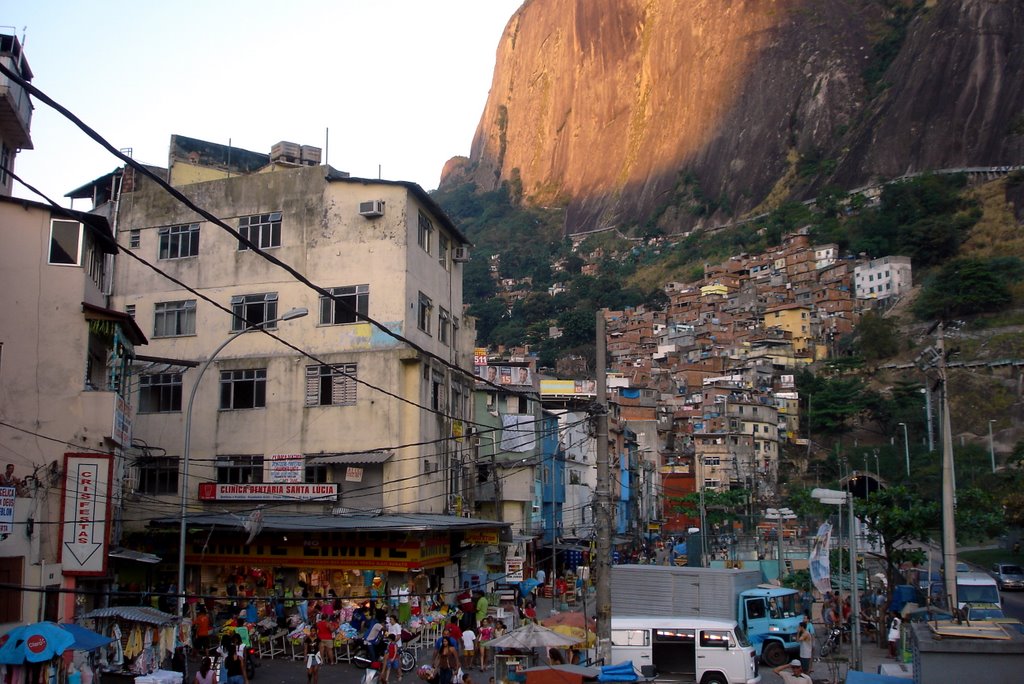
You can see part of it there in the foreground. It's a wonderfully boisterous marketplace, full of merchants and food vendors selling everything from bootleg DVDs and music to soccer jerseys to snacks. Sort of a mini-Urguiana (the huge market downtown) that gets plenty of foot traffic, since most of the buses and vans passing by let off there.

But the plans by In!Rio would definitely wipe out the whole Passarela (in Portuguese only, I'm afraid, but enter the site and click "Explanadas plantas baixas" on the left to get an idea of what they're planning on building, then imagine it replacing what you see in the picture above). In exchange, Rocinha's new entrance could include anything from a shopping mall to a movie theatre to a sports complex with Olympic-sized swimming pools.

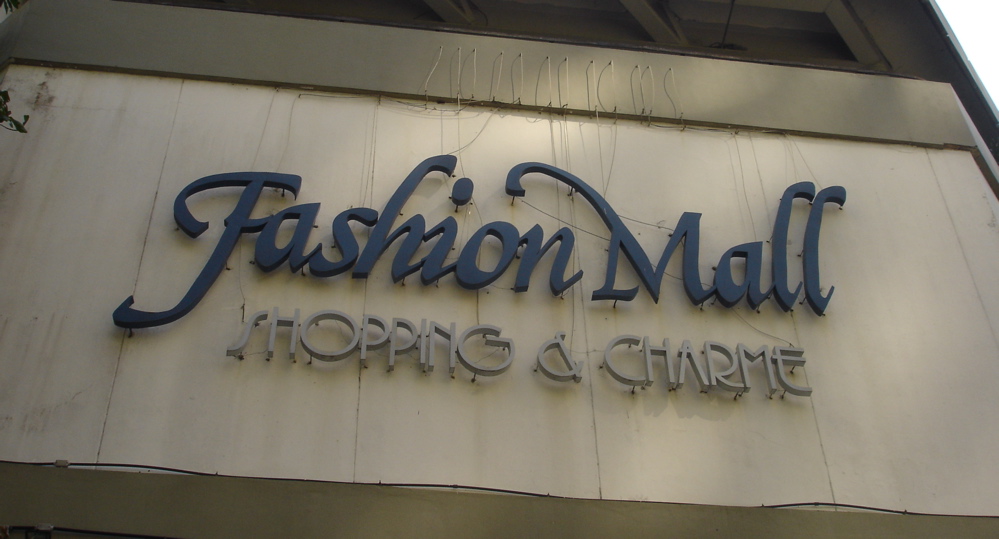
While I try hard not to ghettoize favelas in my mind, eschewing any kind of change, as far as I can tell this project deserves nothing but scorn. There are no indications that this proposal has been discussed with the Residents' Association or that there have been any other attempts at dialogue with the very people it will affect. And of course, the kinds of services it proposes don't appear to be in the price range of favelados any more than the São Conrado Fashion Mall across the street.


[from the home of Versace and Cartier, where I felt underdressed in just a tank top and shorts, you can turn 180° and you'll be looking at that Passarela shot.]

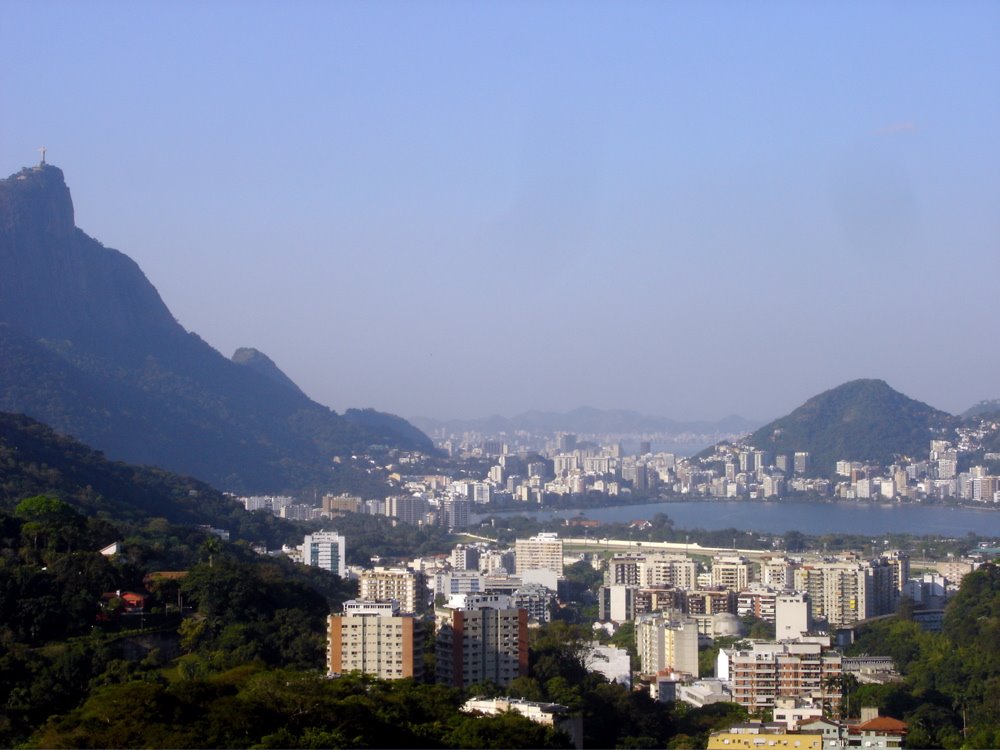
The site and the exhibit also talked about this esplanada plan as a way of increasing tourism to Rocinha. The economic benefits of tourism are undeniable, even if it can be culturally stultifying. Cf favela tourism, a phenomenon of dubious morality, in my opinion. Equating a statue of Jesus or a big hill with gorgeous views (Christo Redentor and Pão de Açucar, respectively) with somebody's neighborhood is a serious act of social objectification. Unsurprisingly, the companies themselves are also of dubious honesty. Matt, one of the other volunteers at Dois Irmãos, is working on a thesis about the gringo fascination with favelas, and discovered that the founder of the leading tour company who makes the claim of being local to Rocinha actually lives in São Conrado -- local geographically speaking, but a far cry from Rocinha socio-economically. And, I might add, it's not too hard to score some of those gorgeous views without paying a tour company. On my last day in Rio, I had one of the mototaxis (motorcycle instead of a car, but same concept) take me up the hill to some good vantage points for pictures.


Getting back to Altere-Rocinha, even if tourists came to some gleaming new citadel of shopping, that doesn't necessarily translate into money being spent in Rocinha. It will probably just push back the (artificial) border beyond which one does not cross, carving out more space that "belongs" to the asfalta and taking away space from the morro. I don't want to perpetuate artificial borders, but they certainly do exist: At the Passarela you'll always see a few police loitering about; walk 20 feet into Rocinha, and you'll just as easily find a gun-toting traficante.

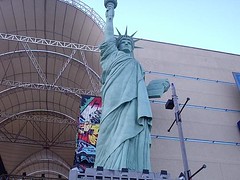
That the city would like to plunk a mall down in front of Rocinha (and in fairness, a mall is one of several proposals, but the concept is the same regardless) is, in the end, not surprising. One of the trends that I found most disturbing in Rio's adoration of American commercial and popular culture was the popularity of malls. In nouveau riche Barra da Tijuca (so wannabe American that, I've been told, residents pronounce the name of their neighborhood as if it were an English word rather than the Portuguese "Bah-ha"), a Southern California-style district of gated communities and guarded condo buildings, the crown jewel is the utterly terrifying Barra Shopping/New York City Center, replete with a mock Statue of Liberty. While Barra Shopping is one of the biggest in South America, I know malls are even more the rage in São Paulo (a common expression claims that what beaches are to cariocas, malls or "os shoppings" in Portuguese -- not too inventive -- are to paulistas). Supposedly they even have a mall entirely dedicated to punk rock.

I could vent for awhile about the deleterious effect of shopping malls, but I'll let the case be made by a much more articulate argument. If you can find it, check out Margaret Crawford's "The World in a Shopping Mall" from Variations on a Theme Park. (Here's a teaser: a Harvard Gazette piece on Crawford's favorable opinion of street vendors -- she's a Harvard Graduate School of Design prof, FYI).

To draw some concluding lines though, one of the main gripes with malls are their controlling effect: it's a managed, top-down environment (truthfully, not unlike a prison), one that tries to manipulate the customer because all interactions take place in the private space of the mall, rather than in the agora, the public space afforded by, say, shopping along a city street. It's that kind of imposed order that to me seems contrary to the nature -- and the successes -- of favelas.

And to bridge from bricks back over to beats, it easily parallels the spontaneous, uncontrolled nature of funk -- outside traditional, structured systems of copyright and industry, but popular and vibrant as a result (and more homogenized and exploitative when within that system, cf Marlboro's Link Records, as I've previously mentioned). I'm sure similar lessons can be glaned from another corner of the blogosphere that spurred me to put something new up here. Check out wayne&wax on "how reggae’s aesthetics emerge from a particular history of practice and technology and copyright law." I'm no expert on the minutiae, but I'm willing to bit the same can be said for funk.

Labels: , , , ,

Friday, July 28, 2006

First Night in Rocinha

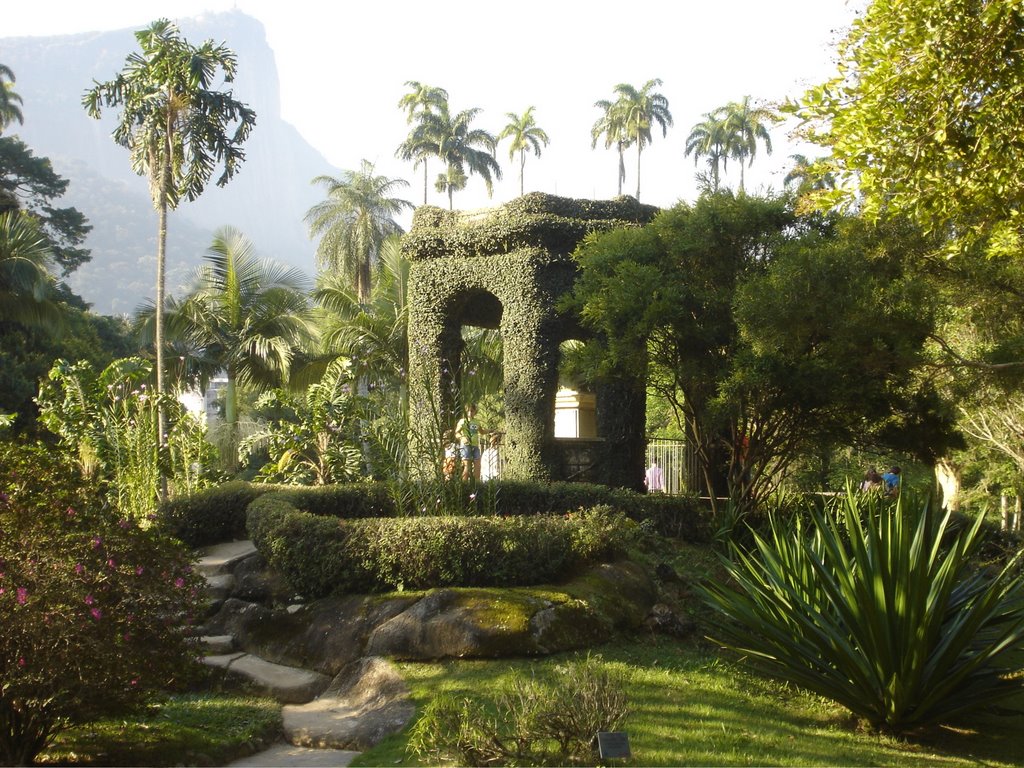
[no, the picture has nothing to do with Rocinha. but as you'll read, I'm in a good mood and thought something leafy & green from the Jardim Botânico would be nice.]
__

So all that negativity from a post back? Forget it, because right after that, just about all of my lobs into the dark came back golden. Shit is on from here out.

Let's start with Rocinha, Rio's largest favela (estimated at 150,000-300,000 residents). Rogerio, from the Fundação Dois Irmãos / Two Brothers Foundations finally got back to me on Tuesday. I called him that afternoon, and, presto: "Do you want to come see a class tonight?" All of a sudden, I was on a bus heading to Rocinha.

If I thought Rio was riotous, then I don't know what to call Rocinha. The entrance alone, a series of stalls called the pasarela, blanket access to the main road up the hill. They have the intensity of a bazaar, crowded & full of jockeying people, selling everything from food & drink to electronics to football jerseys to music -- didn't see any funk on a cursory glance, although I've been told even proibidão (funk that glorifies the drug gangs and as such is banned by the government) can be found there.

Entering Rocinha, I admit I only got a brief glimpse, as the school where the English classes are held was no more than 50 feet in. But it was enough of a glance to create plenty of first impressions. I noticed, for example, the tangles of wires running above the street, described as looking like "postmodern wire sculptures" in one article I read. Legacies of the gatos, those who pirated public services like electricity, they're still there, I imagine, because it doesn't make sense to remove infrastructure, however haphazard, once it's been put up (electric companies have since moved in to offer legal service).

The streets, too, pasarela aside, were a bustle of activity. Bars, lanchenetes, corner stores, kiosks, stalls. It was, all told, a vibrant community.

Compared to Leblon (five minutes -- a tunnel -- a mountain -- and utter separation), the sharpest contrast was definitely in layout. The asfalta (literally "asphalt," meaning middle- and upper-class areas, as compared to the morro, or "hill" of the favelas) is the world of landscaping, gated apartment buildings, 24 hour security, and other obvious luxuries. But it's also the world of right angles. Rocinha, by contrast, meets at any angle that's convenient. Sidestreets barely wide enough for two people to pass. A web as tangled as the wires that crisscross above them.

Convenient, too, that I should see Rocinha for the first time just as I start Edward Said's Orientalism. In the opening chapter, "Knowing the Oriental," he quotes Evelyn Baring, Lord Cromer, England's representatve in Egypt around the turn of the 20th century:

The European is a close reasoner; his statements of fact are devoid of any ambiguity; he is a natural logician, albeit he may not have studied logic; he is by nature sceptical and requires proof before he can accept the truth of any proposition; his trained intelligence works like a piece of mechanism. The mind of the Oriental, on the other hand, like his picturesque streets, is eminently wanting in symmetry.

I obviously don't want to analyze the differences between favela streets and the broad avenues of the wealthier parts of Rio in order to draw the same Orientalist conclusions, but they do reflect certain realities of urban development. The grid structure (which certainly doesn't hold everywhere -- it's plenty easy to get lost downtown) always comes from top-down planning, whether by a surveyor, landowner, or government. Easy to navigate, for commerce and convenience. But the sinuous network of the favela was built from the bottom-up, without land ownership or government planning, designed (or perhaps not designed, but naturally developing) like a code to be understood only by those who live there. Not welcoming to visitors because visitors usually mean bad news (police, rival gangs).

And, moreover, that insider knowledge turns into a tactical advantage, practiced the world over in similarly vulnerable urban communities. A lesson learned by the French during The Battle of Algiers as they tried to penetrate the Casbah (no wonder then, "Bonde de Casbah," the funk track that samples The Clash -- can be heard in Diplo's "Favela on Blast"; will have a stand-alone mp3 soon), Americans in Mogadishu and Baghdad, and police to this day across Rio's hillsides. Politics aside, the moral is the same: Such local communities are not to be fucked with.

So I tread lightly thus far, hope to be able to bring my camera along soon (although Google image search turns up a bundle). Rogerio is taking me to Rocinha's radio station this afternoon, where they broadcast funk, of course. On Friday night I will be going to my first real baile, at Cantagalo, c/o Maga Bo and Adriana Pittigliani (more on her later).

Labels: , , , , ,