Beat Diaspora: Beats, Buses, Bricks

an omnivorous take on music of the beat-based variety and the urban spaces that nurture it

Monday, June 09, 2008

Textual Healing


  • "Reading Place and Space Between Morro and Asfalto: An Itinerary Through the Contemporary Zona Sul of Rio de Janeiro" -- The thesis that, in part, got me across the stage last week
  • "Techno City: Race, Space, and DEMF" -- More organized thoughts on the 313, following the scattershot first impressions post-DEMF.
  • "The Anonymous as Exotic in Presenting Proibidão" -- My BRASA paper gets reprised elsewhere on the Interwebs.

Labels: , , , , , ,

Wednesday, April 30, 2008

Fair Trade Funk

Amidst the brouhaha over anonymity, I need to finally announce a project that I've been working on for nearly two years. I've been hush hush here, not sure exactly how it would turn out, but now it has arrived! Pancadão do Morro: O Funk do Flamin Hotz, Já É? (Big Hits From the Hill: Flamin Hotz Funk, You Down?)

It's a compilation CD of 22 tracks that give a cross-section of funk over the last couple years. More importantly, you can stamp it as "fair trade funk." Every artist has a contract in Portuguese, was paid a sum upfront, and will receive royalties. I can vouch for this personally, as I'm the one who has been orchestrating it all for my friends over at Flamin Hotz Records. Moreover, the CD itself is a gorgeous six panel deal, c/o BustBright, with cover art by funk legend Tony Minister, spot gloss lettering, and two booklets -- featuring lyrics in Portuguese and English, artist bios, and photos. There is no anonymity here.

So put some names and beats with faces, add some well-mastered tamborzão to your collection, and support the hardworking MCs and DJs down in Rio: proceeds are going their way. Trust me, I'll be sending the remittances myself.

Buy it here, here, here, here, here, here, or here. Prices, currencies, and locations may vary!


The promo 12", Funkeiros e Progresso EP, is still available at TTL but going fast for the vinyl fiends, I'm sure.
___

By way of some explanation, I got in touch with Flamin Hotz back in the spring of 2006 after purchasing a copy of the Sou Funk EP and subsequently asking them how such a project came about. The response was stark and simple: the whole thing was a bootleg job. The artists didn't get paid, probably didn't even know the record existed. It had already stirred things up on the Hollerboard by the time I got ahold of Casi, the label head (of a two-man operation) and he was feeling pretty low about it.

He proposed the idea of a new release done properly, which coincided perfectly with my desire to, in some fashion, repay the folks in Rio who had been kind enough to take me around, answer my questions, and introduce me to other people in the movimento funk.

Unfortunately, nothing happens in Rio that doesn't happen face to face, thus two years is really just a few months' effort of when I could actually be there to move it along.

But the EP is out, the CD is out, and hopefully it will be the beginning of much more funk moving its way up north through ethical channels.

As for making amends, I did try to reach the artists from Sou Funk and pay them retroactively on FHZ's behalf. In the case of MCs Júnior and Leonardo, residents of Rocinha whose house abuts the Two Brothers building (in a city of 13 million, in a community of 250,000, what are the odds . . . ?), I pulled it off:

Labels: , , , ,

Wednesday, April 23, 2008

Unlabeled: The Anonymous as Exotic in Presenting Proibidão

[Update: The folks at norient.com liked this paper enough to publish it. It's missing the hyperlinks from the blogaversion, but still nice to see it circulated it further afield.]

[The reason I went on down to New Orleans after all was for the BRASA conference, where I appeared on the panel: "Raps do Parapapá: Representations of Violence in Brazilian Funk Carioca," organized by Paul Sneed, of 2Bros fame. Below is the paper I presented, modified for the blogging public with some links &c]

The existence of this CD, Proibidão CV, the subject of my talk, is due in no small part to the efforts of American DJ Wesley Pentz, aka Diplo, who first brought funk to a certain kind of American audience: young, musically au courant, tapped into wider hip-hop and dance music scenes that include music from across the United States, Jamaica, other parts of the Caribbean, the UK, Latin America, and increasingly Africa. Beginning in 2003, he released two funk mixes, “Favela On Blast” and “Favela Strikes Back”, and included several funk tracks on his mixtape “Piracy Funds Terrorism,” which was a promotional tool for the Sri Lankan by way of London artist M.I.A., who in turn borrowed some aspects of funk to make a bricolage of global urban beats that catapulted her to pop stardom.

However, whether out of a desire to monopolize access to funk or simply out of carelessness or even ignorance, Diplo’s inaugural funk efforts were notoriously devoid of any contextual information. In particular, artist and track names are simply nonexistent. The two exclusively funk mixes do not come with track listings even though some tracks are by extremely well known artists like Bonde do Vinho. The mixtape, meanwhile, is more egregious. It features a mixture of commercial hip-hop, recordings of M.I.A., and funk. The latter, however, is listed only as “Baile Funk 1,” “Baile Funk 2,” “Baile Funk 3.” [I should add that “baile funk” has become the name for funk among non-Brazilians.]

Diplo was criticized somewhat for this disservice, although ultimately let off the hook. Music critic Nick Sylvester, reviewing Favela Strikes Back for Pitchfork Media in June 2005, argues “But 10 wrongs do make five rights, and if Diplo’s shtick is bringing this shanty to the world in a way they might respond to and ultimately might take vested interest in (read: $$$), then let’s drop the charges for now and indulge the music as wide-eyed as he does.” While I don’t share Sylvester’s laissez-faire attitude, I’ll nevertheless point out that Diplo has at least made recent efforts to act less like a “culture vulture,” including plans to open a branch of HeapsDecent, an NGO that offers music production workshops, in the favela of Cantagalo in the Zona Sul of Rio de Janeiro. He is also working on a movie, Favela On Blast, that purports to put names, faces, and stories to what he had previously presented as anonymous.

Anonymity, however, is the order of the day in this recent release by the label Sublime Frequencies, Proibidão C.V.: Forbidden Gang Funk from Rio de Janeiro. Its liner notes, after providing a brief, simplified, and somewhat inaccurate explanation of proibidão, read: “Recorded and assembled by Carlos Casas. Courtesy of some anonymous MCs and DJs in different bailes along the favelas of Zona Sul, Rio de Janeiro during March-April 2003.” On the opposing page, it prominently states: “All artists are Anonymous. All tracks are Untitled.” It then lists the tracks as “Untitled Proibidao CV” numbers 1-17. [Italics are my own.] For the listener who doesn’t know any Portuguese that, unfortunately, is the end of it. However, a closer listen reveals a more complex CD than the providers are willing to admit, or perhaps are even aware of, in their liner notes.

To begin with, there is little indication that all of the tracks take place in the Zona Sul, as track 3 sings of “tranqulidade na Mangueira,” track 10 speaks of a “Festa da Jacaré” in addition to mentioning Vidigal, both 7 and 11 indicate that they are from “Borel”, and #2 perform the well-known trope of poetically listing a series of favelas from across the city. Conversely, Rocinha, the stated source of the photographs in the CD package, is not mentioned once. Instead, the photos, which do not document any act of criminal behavior to my eye, implicitly link favelas with the drug trade. It’s an unfair generalization — a CD of proibidão, therefore it needs photos of favelas no matter what they show.

The liner notes also mention “the explicit lyrics of apology to drug gangs and the violent content.” I will not dispute that this is present, as tracks 4 & 5 – which appear to be a continuation of the same live recording and not separate tracks – declare, “Hoje vai ter churrasco pra geral / só ninguém vai comer” when speaking of burnt bodies in a prison riot at Bangú 1. On the other hand, there is a more thoughtful view in track #15.

It opens with a protest against stereotypes in a clever call and response: “Dizem que nós somos violentos / Mas desse jeito eu não aguento / Dizem que lá falta educação / Não é desse jeito não / Dizem que não temos competência / Mas isso sim que é violência / Que só sabemos fazer refrão.” (They say we're violent / But this shit I don't buy / They say we lack education / That's not it at all / They say we're not competent / But that right there is violence / That we only know how to cut refrains") Later, the MC sings affirmatively: “Nós temos escola / nós temos respeito” (We have schools / we have respect) and “cidadão brasileiro e tenho meu valor" (Brazilian citizen and I have my value). Such sentiments are hardly the one-dimensional view that the CD Proibidão CV presents. The prominent spelling of “Cidade de Deus” also makes it clear that this is another track not from the Zona Sul.

Likewise, something beyond apology for the drug trade is taking place in track #12. While the reference to the Comando Vermelho motto “Paz, Justiz, e Liberdade” would affirm its status as proibidão, the earlier lines are of considerable interest. “Eu sei que um dia a gente saí daqui / Não sei o dia e nem sei a hora. / Mas sei que um dia a gente vai embora.” There is an escapist, and I believe even utopian, impulse in these lines. Will “a gente” leave by escaping the cycle of violence, by leaving their community, by dying in a blaze of glory in a gun battle? This open-ended vision credits more toward the insightful analysis of Paul Sneed, who I’m sharing this table with, in his dissertation on proibidão: “Machine Gun Voices: Bandits, Favelas and Utopia in Brazilian Funk.”

Indeed, it is precisely a perspective like Paul’s this is lacking in Sublime Frequencies’ presentation of proibidão. They conclude in the liner notes, “This CD is in no way an apology for these groups, but a document to portray a moment in time in Rio de Janeiro musical and social history.” On their website, meanwhile, they declare the label’s mission: “SUBLIME FREQUENCIES is a collective of explorers dedicated to acquiring and exposing obscure sights and sounds from modern and traditional urban and rural frontiers via film and video, field recordings, radio and short wave transmissions, international folk and pop music, sound anomalies, and other forms of human and natural expression not documented sufficiently through all channels of academic research, the modern recording industry, media, or corporate foundations.”

Such rhetoric is a dodge. If indeed they are “explorers” on the “urban frontier” of Rio de Janeiro seeking to “portray” a particular “moment,” then they are uninformed explorers who make no effort to explain the parameters of that moment – where, when, why. Instead, they let the listener concoct his or her own vision of Rio’s favelas based on abrasive beats, gruff voices, and the sampled sound of gunshots.

Such a proposition – suggesting the violence of Rio’s favelas without fleshing that concept in with details – is reminiscent of the attitude that Alex Bellos takes in an article on proibidão for online music publication Blender. He opens the article, “Coke. Guns. Booty. Beats.” with the declaration that funk is “the most dangerous – and most exciting – underground club scene in the world.” The implicit link, however, is that it is the most exciting because it is the most dangerous. The same principle is at work in Proibidão C.V. – one doesn’t need to actually know what the songs are saying; rather, the music should be exciting simply because of its violent, dangerous context. In both cases, exciting is also a substitute for exotic, for the exotic is exciting as well because it intimates danger. I should add that Sublime Frequencies traffics principally in “exotic” locales like “Java, Bali, Sumatra, Burma, Morocco, Thailand, India, Mali, Syria, Laos, Cambodia, and Nepal.”

Anonymity, then, is indeed the rub. I am certain that a lack of knowledge of Portuguese, both among foreigners like Diplo and among their audience, plays a role. However, I think there is a more sinister impulse at work as well. For anonymity ultimately implies unknowability. Radical urbanist Mike Davis provides a chilling account of the consequences of unknowability in Planet of Slums. He concludes the book by arguing that the Pentagon is the only global institution to take seriously the implications of rapid slum growth in large urban areas. He cites U.S. military tactics, which “assert that the ‘feral, failed cities’ of the Third World – especially their slum outskirts – will be the distinctive battlespace of the twenty-first century” and continues by quoting an Air Force theorist writing in the Aerospace Power Journal: “Rapid urbanization in developing countries results in a battlespace environment that is decreasingly knowable since it is increasingly unplanned.” But the attitude that slums are going to be the next global battleground, perhaps because of their unknowability, is not limited to the U.S. military. One only need look as far as a recent edition of O Globo to find the polícia civil or, in more extreme cases, the BOPE in blockbuster hit Tropa de elite, engaging in such tactics, trying to bring Rio’s favelas back under the city’s control. Unplanned favelas are unknowable spaces to the uninitiated. They are, moreover, soundtracked by proibidão. But when proibidão is presented as anonymous and unknowable, as in the case here, then it does nothing to increase knowledge – and knowability – about both the music and its environment. Instead, it only encourages the exoticization of both, a process whose consequences may be extremely dire.

Labels: , , , , ,

Monday, December 17, 2007

Stirring the Pot

Timo (aka DJ Rideon) was kind enough to big up my mix A Seleção do Gringo on the Rio Baile Funk blog. But he raised some questions about my admittedly ad homonym (or at the very least sneaky linky) digs at some of my fellow "funky mediators." I expected as much and he's fair to call me out on my URL trickery, so lemme explain:

Diplo -- I've been writing about funk&Rio, among other sounds&cities, for going on a year and a half, but I've largely avoided mentioning Mr. Pentz, whose shadow certainly looms large over the crowd of gringos who've gone south. I have to admit that back in the spring of '06, I was still easing my way into the heady world of int'l sounds, c/o knowledge jewels like Music E-145 (and hey, now I'm the TA!). And it was via Diplodocus that I, like many who live above the equator, first heard of Rio's booty beats. Not that there weren't contemporaries or even precursors -- cf DJ Philomena and the unfortunately-named Slum Dunk Presents Funk Carioca (in part orchestrated by Tetine, who claim the equally unfortunately-named album L.I.C.K. M.Y. F.A.V.E.L.A.)

But I'm definitely of the opinion that some of his early efforts at popularizing the genre were problematic.


Favela On Blast / Favela Strikes Back / Piracy Funds Terrorism


This mixtape triptych from '04, when funk was the hottest thing in the Diplo repetoire, is shockingly disrespectful to the music he was building a reputation on (not to mention the cavalier use of "favela"). All three do not credit any tracks with artists or titles, and in Piracy Funds Terrorism, tracks named "Baile Funk 1" "Baile Funk 2" &c brush up with properly credited MIA mash-ups and dirty south hits.

Why are funk MCs less important as artists than The Clipse?

I'll grant that o movimento funk itself is not known for its scrupulous organization, and plenty of mixtapes you pick up in Rio are creditless too. But it's not like Favela On Blast is chock full of hardcore proibidão (where anonymity is the order of the day) -- it's got mainstream funk hits like Bonde do Vinho's "Labarinto vs. Vem Cá Nenem" (popular here too for using a "Rock the Casbah" instrumental) and one of the many remixes of the Flamengo anthem (both of which are on Seleção do Gringo, properly credited).

Timo points out that I, too, have some uncredited tracks in my mix -- but I tried to avoid them (they are the exception, not the rule) and at the very least I explain why I don't have the info, even after some hunting around Google Brasil.

A review of Favela Strikes Back ultimately argues that such culture vulture moves may not be so bad if, in turn, they translate into $$ (or more precisely R$R$) in the hands of artists, although the review itself really flounders with terms to describe the music (hardly an unknown occurrence outside their indie rock bread and butter). Difficult questions about favela economics (will it just lead to more gringos buying drugs?) and commodification aside, I agree that Diplo and early funkeiros up north certainly paved the way for DJ Sany Pitbull, DJ Sandrinho, and MC Dudu do Borel (among others) to bring the funk direct without relying on such mediators. But how much of a north-south reversal are they making if Sany ends up playing at a place called Favela Chic, which could easily happen the night after he plays the baile funk in the favela of Cantagalo (which in turn I've heard called "baile chique" because of the number of well-heeled cariocas that have been coming up for the party)? And of course, it's only a select class who are making the leap outside of their communities, much less Rio. Trickle-down economics definitely don't apply.

This is, of course, dating back a few years, and I applaud more recent efforts like HeapsDecent and the Favela On Blast film (which could go either way) as making up a little bit for past transgressions.

It's a question if he can really focus long enough on these projects to make sure they come to fruition properly. As Wayne&Wax has already pointed out, move too quick and you'll miss the details.

[After delivering a similar argument in a Music E-145 guest lecture two weeks ago, I copped Soy Cumbia!, a MadDecent podcast mix that is mad indecent -- BsAs champ Sonido Martines loses remix credit and rumor has it that vocal drops and shout outs (y'know, local color, marks of identification) were cut from the beginning of the tracks. Just go listen to Sonido on RuptureRadio . . . he spends a lot more time in BsAs than Philly's finest.]


Essay/Man Recordings: As an acknowledged commercial success with two hit compilations, it might just seem like a case of jealousy. But I think these comps were another opportunity squandered -- the cropped mid-sections of the first cover replicating the same anonymous-as-exotic canard of Diplo's mis- or non-labeling. I feel better about the more recent Funk Mundial and Baile Funk Masters series, as they actually draws distinctions between different DJs and MCs, their personalities, the styles they bring to the table. Funk is not monolithic in this format, and that's a big improvement. Still, as recently as this summer, an MC I'm friendly with who ended up on this release said the contract presented to her was in English and explained to her by a (European) bilingual friend of Man's man on the ground, Daniel Haaksman, who in turn is still struggling through his Portuguese ABCs. I'm really shocked that after so many releases, they haven't gotten their act together enough to find a Brazilian lawyer and draft a contract in the lingua franca (or just have a notário do a certified translation). I haven't seen the contract, although I offered to look it over, so I don't want to claim that it was misrepresented or offers poor terms, but the fact of it still strikes me as a disservice.

CokeGunsBootyBeats: My favorite example of hyper-sensationalized funk coverage. This guy Alex Bellos, "reporting deep from the slums of Rio de Janeiro" like a modern-day Livingstone, has produced one of the most telling statements in English-language press about o mundo funk carioca. "Welcome to the most exciting--and the most dangerous--underground club scene in the world." The real message here is that it's the most exciting because it's the most dangerous. The interest of Bellos ("a world expert on Brazil" ?! -- stick to futebol) and his readership is fueled by an image -- even a fantasy -- of drug- and violence-infested third world slums populated by 12 year olds snorting cocaine and holding AK-47s. Does proibidão, the focus on Bellos' article, revolve around the culture of drug trafficking in Rio? Of course. But it doesn't require such preposterous reporting, cf Machine Gun Voices.
___

All of which makes me appreciate all the more the kind of approach engendered by the Blogariddims series. I realize I'm comparing apples to oranges with a podcast stacked up against record label releases, mixtapes, journalism, and well, another podcast. But there's room in each to show a little more care (and interest -- is it about you or the artists you're bringing to another audience?) w/r/t cross-cultural contact.

Moral of the story: If the world were more like Blogariddims, maybe it'd be a more ethical place.

Labels: , , , , , ,

Friday, July 28, 2006

First Night in Rocinha

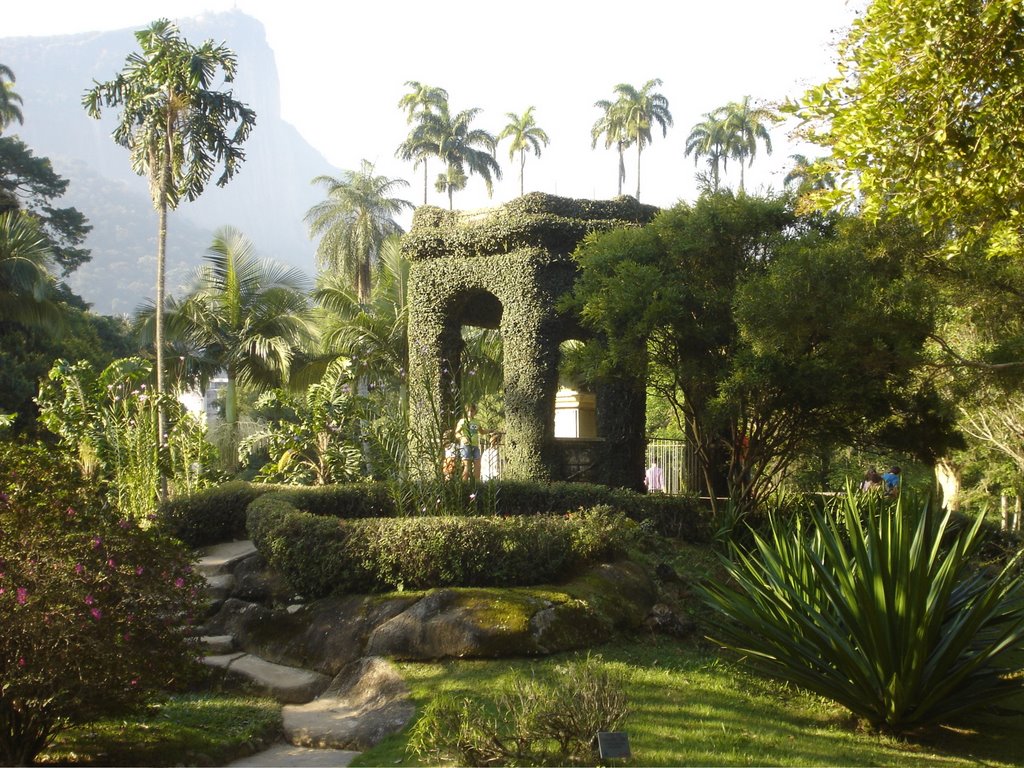
[no, the picture has nothing to do with Rocinha. but as you'll read, I'm in a good mood and thought something leafy & green from the Jardim Botânico would be nice.]
__

So all that negativity from a post back? Forget it, because right after that, just about all of my lobs into the dark came back golden. Shit is on from here out.

Let's start with Rocinha, Rio's largest favela (estimated at 150,000-300,000 residents). Rogerio, from the Fundação Dois Irmãos / Two Brothers Foundations finally got back to me on Tuesday. I called him that afternoon, and, presto: "Do you want to come see a class tonight?" All of a sudden, I was on a bus heading to Rocinha.

If I thought Rio was riotous, then I don't know what to call Rocinha. The entrance alone, a series of stalls called the pasarela, blanket access to the main road up the hill. They have the intensity of a bazaar, crowded & full of jockeying people, selling everything from food & drink to electronics to football jerseys to music -- didn't see any funk on a cursory glance, although I've been told even proibidão (funk that glorifies the drug gangs and as such is banned by the government) can be found there.

Entering Rocinha, I admit I only got a brief glimpse, as the school where the English classes are held was no more than 50 feet in. But it was enough of a glance to create plenty of first impressions. I noticed, for example, the tangles of wires running above the street, described as looking like "postmodern wire sculptures" in one article I read. Legacies of the gatos, those who pirated public services like electricity, they're still there, I imagine, because it doesn't make sense to remove infrastructure, however haphazard, once it's been put up (electric companies have since moved in to offer legal service).

The streets, too, pasarela aside, were a bustle of activity. Bars, lanchenetes, corner stores, kiosks, stalls. It was, all told, a vibrant community.

Compared to Leblon (five minutes -- a tunnel -- a mountain -- and utter separation), the sharpest contrast was definitely in layout. The asfalta (literally "asphalt," meaning middle- and upper-class areas, as compared to the morro, or "hill" of the favelas) is the world of landscaping, gated apartment buildings, 24 hour security, and other obvious luxuries. But it's also the world of right angles. Rocinha, by contrast, meets at any angle that's convenient. Sidestreets barely wide enough for two people to pass. A web as tangled as the wires that crisscross above them.

Convenient, too, that I should see Rocinha for the first time just as I start Edward Said's Orientalism. In the opening chapter, "Knowing the Oriental," he quotes Evelyn Baring, Lord Cromer, England's representatve in Egypt around the turn of the 20th century:

The European is a close reasoner; his statements of fact are devoid of any ambiguity; he is a natural logician, albeit he may not have studied logic; he is by nature sceptical and requires proof before he can accept the truth of any proposition; his trained intelligence works like a piece of mechanism. The mind of the Oriental, on the other hand, like his picturesque streets, is eminently wanting in symmetry.

I obviously don't want to analyze the differences between favela streets and the broad avenues of the wealthier parts of Rio in order to draw the same Orientalist conclusions, but they do reflect certain realities of urban development. The grid structure (which certainly doesn't hold everywhere -- it's plenty easy to get lost downtown) always comes from top-down planning, whether by a surveyor, landowner, or government. Easy to navigate, for commerce and convenience. But the sinuous network of the favela was built from the bottom-up, without land ownership or government planning, designed (or perhaps not designed, but naturally developing) like a code to be understood only by those who live there. Not welcoming to visitors because visitors usually mean bad news (police, rival gangs).

And, moreover, that insider knowledge turns into a tactical advantage, practiced the world over in similarly vulnerable urban communities. A lesson learned by the French during The Battle of Algiers as they tried to penetrate the Casbah (no wonder then, "Bonde de Casbah," the funk track that samples The Clash -- can be heard in Diplo's "Favela on Blast"; will have a stand-alone mp3 soon), Americans in Mogadishu and Baghdad, and police to this day across Rio's hillsides. Politics aside, the moral is the same: Such local communities are not to be fucked with.

So I tread lightly thus far, hope to be able to bring my camera along soon (although Google image search turns up a bundle). Rogerio is taking me to Rocinha's radio station this afternoon, where they broadcast funk, of course. On Friday night I will be going to my first real baile, at Cantagalo, c/o Maga Bo and Adriana Pittigliani (more on her later).

Labels: , , , , ,