I promised months ago to post Paul Sneed's doctoral thesis on
proibidão funk. I haven't a single a good reason why I've neglected to do so, but as I finally start classes here in Paris, there's no time like the present.
For all the students, professors, and otherwise academics out there (that includes beat researchers), add this to your syllabus:
Machine Gun Voices: Bandits, Favelas, and Utopia in Brazilian FunkI did hold off until I finished it (which was while still in Rio, figures), as I wanted to present my thoughts in full. But I'm willing to sacrifice my book review ambitions just to get the damn thing out into the public domain, having received Paul's permission.
It's a brilliant work, in my opinion, as it takes the courageous step of treating funk as a musical style whose lyrical content and performative aspects are worthy of socio-political commentary. Not that I disagree, of course, but as Paul himself writes in the introduction, "Before moving to Rocinha in 1990, I had been living in a mansion in Rio’s chic beachfront São Conrado neighborhood. When I told dona Ilsa, the kindly, wealthy, white elderly woman with whom I had been living where I was moving, she asked me why, on Earth, I would want to live in a favela. I couldn’t move to Rocinha, she said, and surely I would be kidnapped, killed or worse! When I replied that I wanted to learn about the culture of the people in Rocinha, she laughed and informed me that, 'Those people don’t have culture!'"
Of course, opinions have progressed since then, but certainly his choice of thesis topic requires staking out more ground to justify such a project than, say, writing on
Camões.
Beyond the ambition of the book, its execution is remarkable. As the above quote hints, Paul has lived in Rocinha on and off since 1990, making his study of funk a subjective one -- it comes from having become, as best as a
gringo can, a
funkeiro. This
in medias res approach well positions him to perceive the role of the funk MC and the content of MC's lyrics vis-a-vis the
traficantes and the community at large. The
proibidão MC, Paul argues, is really in the role of social mediator. As an inbetween figure -- not quite a drug trafficker, but closer to the ruling gang than the average resident -- the MC articulates the rules of the
favela. Moreover, he articulates them
from the community
to the gang leaders. The baile is a social stage, an event where communication occurs between the two constituents of the
favela that couldn't otherwise take place.
From interviews with MCs to analysis of lyrics (don't sleep on the appendix of
proibidão lyrics -- most of which had never been transcribed, much less translated), it's an internal study of funk, acknowledging the criticisms of the music, but certainly coming from the perspective of an unabashed fan. Not to say, of course, that it doesn't also bring a sharpened critical appartus to bear on it all.
N.B. It's long & academic in style (natch -- it's someone's doctoral thesis), but also doesn't translate a lot of Portuguese quotations because it was submitted within the Portuguese department. If you're really curious I'd be happy to help you out.
Babelfish is always an unreliable tool for large amounts of text.
__
In conjunction with all this, if you happen to find you've got money to burn in your pockets, consider donating to the
Two Brothers Foundation, the non-profit Paul founded to offer English classes and other cross-cultural opportunities in Rocinha. We're in the midst of a $10,000 fundraising campaign to finish renovations on their new building. Over halfway there, but every bit counts in getting to the finish line.
If you'd like more information -- or know of someone who might be interested -- I have a package prepared with text & video that explains Rio, Rocinha, and Two Brothers in layman's terms. I'm happy to send them out to anyone.
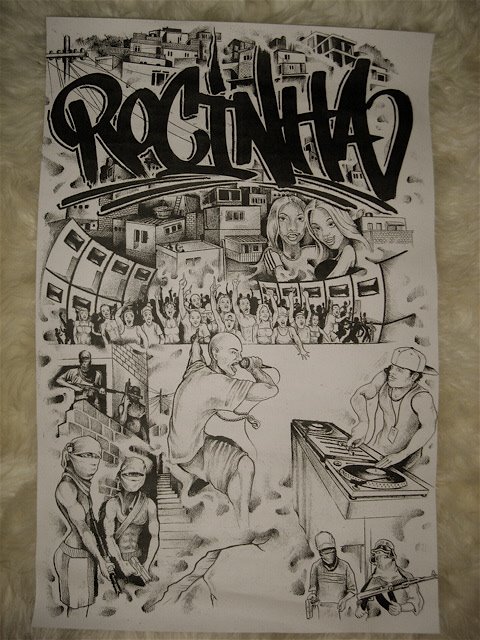
While we're all up on the Rocinha love right now, here, as a parting shot, is a fresh drawing from Zezinho DJ, a Rocinha resident studying music production in San Francisco. He's been very friendly & helpful to me re: all things funk ("o funk e minha vida" -- "funk is my life", as his motto goes), and clearly dreams often of his city on a hill and the sound that weaves it together.
Labels: favelas, funk, rio, text, theory