Beat Diaspora: Beats, Buses, Bricks

an omnivorous take on music of the beat-based variety and the urban spaces that nurture it

Monday, October 23, 2006

anniversary, for better or worse




There's been a buzz around Paris w/r/t October 27, 2006: one year on from the death of two youths in Clichy-sous-bois, a poor neighborhood outside of Paris, who ran into an electrical grid while most likely fleeing police. The event sparked "riots" across the cités (large housing projects) of the banlieue (suburbs), from Clichy-sous-bois to the rest of Paris's suburbs to every major city in France (to even, as I just learned, Guadeloupe). They were vastly mischaracterized in the American press -- I recall, for example, a New York Times' editorial entitled "Paris is Burning", when the point was precisely that Paris was completely calm while the periphery had erupted into a conflagration. Or perhaps it was just a question of emphasis. Setting cars on fire was the typical MO, but it was only buried deep in an article that I would find a sentence along the lines of "riots in the French suburbs subsided last night as the number of car burnings dropped to average levels." Those average levels, meanwhile, were something like several hundred cars a night! Sure, the sharp spike was something to take notice of, but the basic act of protest wasn't anything new.

So I'm not surprised to read, as in this BBC piece, "The conditions that led to the 2005 unrest are still in place." That seems to be the main conclusion drawn by the outpouring of banlieue commentary. Le Monde, the country's leading newspaper, has certainly wanted their fill: an 8-page supplement on Thursday and the cover of their political magazine.
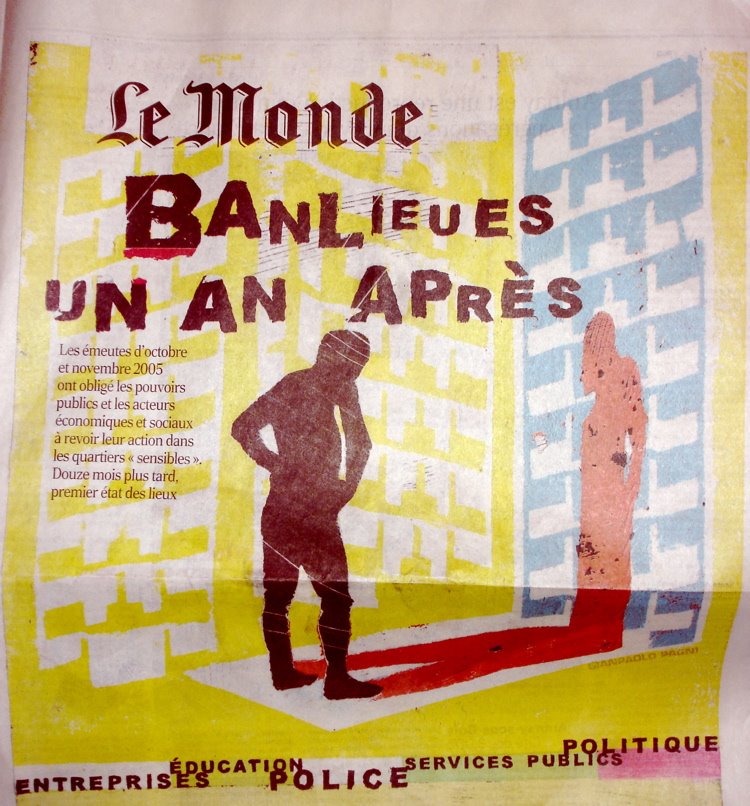
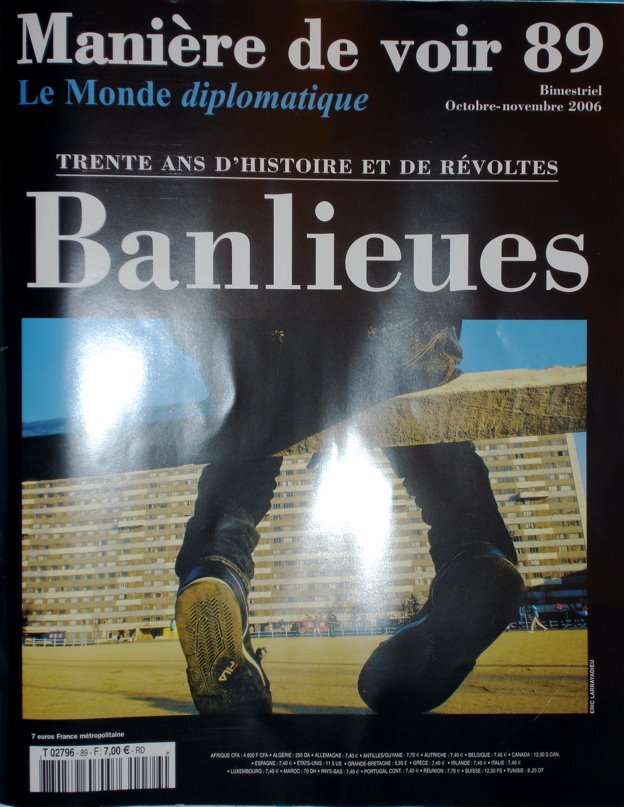


The two features make for an instructive contrast. On the left, "Banlieues un an après" (Banlieues one year after), and on the right, "Trente ans d'histoire et de révoltes" (Thirty years of history and revolts). The former is stuck in a naïve mindset, one that I imagine was shocked such events could happen in the first place and certainly hasn't learned much since, even though, for example, a popular movie like La Haine came out over ten years ago! Why talk of one year after when it's really a question of, as the latter seems to better understand, thirty years before?

Or longer, for that matter. Between 1945 and 1971, approximately 6.5 million units of housing were built in France. At an average occupancy of 4 persons per unit, that's 26 million people. In 1971, the population of France was roughly 50 million people. Astounding rates of post-war growth and construction? Sounds like a baby boom to me, not a big deal. Except that of those 6.5 million units of housing, 2 million were HLM (habitation à loyer modéré -- rent-controlled housing, aka cités) and 3 million were publicly financed in some manner. Given that those 3 million aren't necessarily all cités of some kind, you can calculate that roughly 15-35% of the French lived in such projects. And that was in 1971. Wikipedia picks up the slack and brings it to the present day: There are now approx. 4 million HLM housing units, home to roughly 14 million people, or one-quarter of France's population.

What makes cité life provoke such hostile reactions? Certainly there are obvious economic and cultural reasons: high unemployment, endemic job discrimination (a plan to institute anonymous résumés -- so employers can't immediately toss their Mohammets into the rejection pile because they're looking to hire Jacques -- recently got scrapped in the National Assembly), and the resentment of outsider status. Huge problems for which I'm hardly equipped to provide solutions.

A more manageable question, however, might center around where and how the violence was carried out. It struck me that, as far as I could tell from media coverage, those perpetrating the unrest mostly were doing so in their own neighborhoods. Paris proper was untouched for a reason, in that sense -- the geography of the banlieues keeps them a substantial train ride away. Granted, I have seen some bidonvilles tucked into corners along the Seine, but I have to imagine anyone squatting on central Parisian real estate wants to lay low (bidonville can refer to anything from a "tent city" to a "shanty town" -- in this case I'm referring to more of the former, the rows of tents you can find on some of the left bank quais).

So there's a geographical segregation, coupled with a built environment that, on the whole, isn't very appealing: large, co
ncrete apartment blocks. Lots of them. Moreover, and maybe even more importantly, they've been provided by the government. Crucially, this means there's no sense of ownership. Of course, no one was ready to go torch their homes, but to burn cars, police stations, even schools and community centers -- to add a lot of charred wreckage to an already bleak landscape -- probably wasn't accompanied by a lot of tears. An environment like that just doesn't engender a lot of attachment.

Naturally, I can't help but think about favelas in Rio by comparison -- where it's the exact opposite. Of course social unrest has occurred in the city for decades. The '90s in particular were considered something of a nadir, as I've been reading in Cidade Partida ("Divided City"). Of particular note in light of the banlieue are the clashes between funkeiros that occurred on the beaches of Ipanema and Copacabana (around '93, I believe). When tension reached a head, they didn't destroy their own communities -- precisely because their communities are their own. I can't imagine anyone setting a car in their own favela on fire. The sense of pride and resilience is simply too strong. Destruction caused by warring gangs is of course another story, but I've never heard of a gang tearing down a favela -- that's the kind of thing the government is more likely to propose.

In Rio the poor build themselves homes they are proud of in spite of the government so they don't always have to live peripherally. / In Paris the government builds homes for the poor they have no attachment to and forces them to live peripherally.

So when Rio's huddled masses want to be heard, how do they do it? Throw a baile funk. Let that bass trickle down the hillsides -- and yes, you can be in a neighborhood of the asfalta and hear the soundsystem up on the morro. And outside Paris, they let flames cascade upward, hoping those lucky enough to be inside the Boulevard Périphérique look up & notice.

all just ways of rendering the invisible visible, some more destructive than others.
____

Easy to get grandiose & general, which can be dangerous & dishonest. To refocus:

1. banlieue, like favela, is a vastly overwrought term at this point, and can hardly be spoken of in monolithic terms
2. the cités are also there to stay -- it's a fait accompli: there's no chance the government is going to rip them all down and somehow integrate millions of people into already-dense Paris
3. so what's going on besides focusing on violence (of which, fortunately, there doesn't seem to have been any to "mark" the anniversary)? besides the same kind of sensationalization you deplored in opinions of favelas?

Well, Le Monde Diplomatique, the magazine cover on the right side that I never got back to, already seems to be pointing in that direction. The inside flap ad
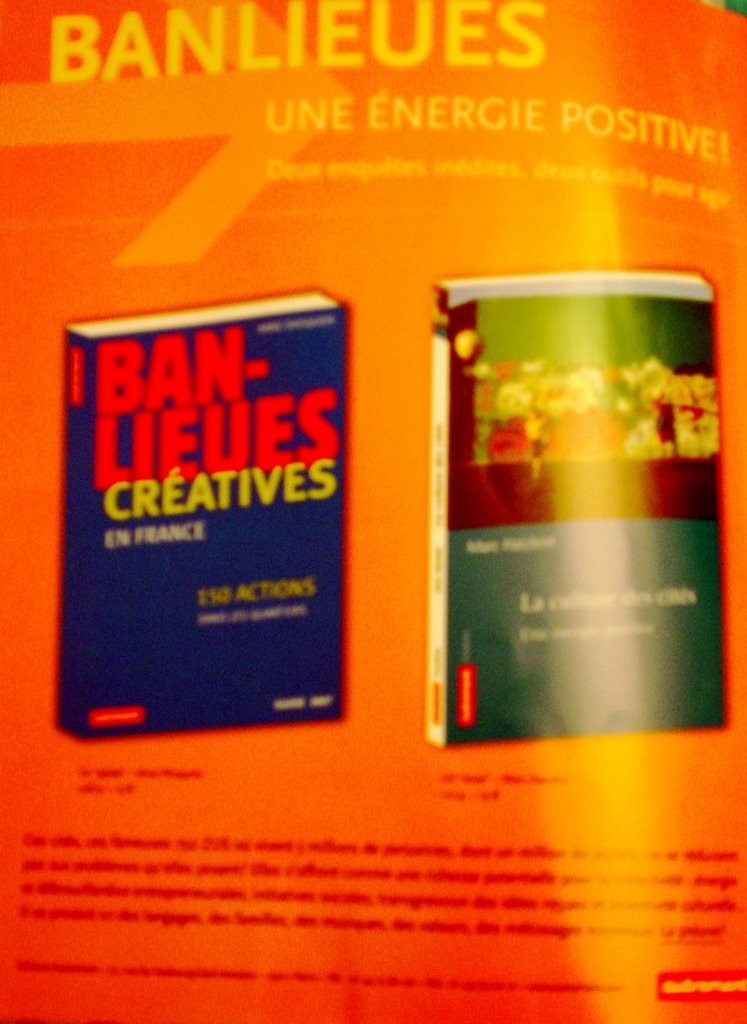
sets the tone dramatically. "Banlieues: A positive energy!", "Creative Banlieues", "The Culture of the Cités." The "Banlieue One Year After" insert deserves some credit too, even if I don't like the presentation. In a particularly carioca moment, there's an article on the resident of a cité in Marseille who proudly shows off a commanding view of the city, port, and ocean that only his home turf offers.

I'm wondering too, with all the downtime unemployment offers, if there's a music scene of some kind stirring about on the outskirts of town & more importantly how I can find it. Le Monde was fascinated a week ago (en français, sorry) with one way the bored youth pass their time: blogging. The subtitle (translated) reads, "The cités of the banlieue play out rivalries with one another on the Net via hundreds of blogs. They're violent, territorial, provocative. Choice excerpts -- with their spelling." [the posts are full of slang, esp. verlan, where the syllables of a word are reversed. merits its own analysis some other time.]

The author of this piece clearly doesn't have a healthy sense of exaggeration. Someone's profile reads, "Welcome to Mureaux. Number of residents: around 30,000. Crime rate: 97%. Chance of visiting & leaving alive: Almost nil. From the moment you pass the sign, the game begins." Maybe Mureaux really is that rough, but I detect a pretty obvious tough guy façade there. It fits in line with what the article quotes at the beginning, that the blogs argue over which neighborhood is the scariest, "the hottest," "the ghettoest." Again I can't help but compare: the youth of the favela will instead take pride in having the best baile around.

I would link to some of the blogs -- and indeed have been meaning to try and contact the authors -- but as I just discovered, their host shut them all down for "not following the terms of the website." Somehow not surprising.

So where does that leave me? I didn't come to Paris to visit cités in the same way that favelas were an integral part of my plans in Rio. But I'm absolutely of the mindset that all parts of a city deserve attention -- peripheries as much as centers. It's remarkable how effective out of sight/out of mind is: I couldn't help but be reminded of favelas every day in Rio, while it's taken this artificial anniversary to get me thinking more seriously about the banlieue.

And yet, three days a week I'm heading to St-Denis (a municipality that, technically, is in the banlieue) for my classes at Université-Paris-VIII, the most radical of the post-'68 campuses (psychoanalysis program founded by Lacan, philosophy dept founded by Foucault . . . you get the idea). The kind of place that even has an academic program on connaissance
(familiarity or knowledge) de la banelieue. Soon enough, I suppose: I'm taking a class on the problems cities face in the era of globalization, and the professor promised to give me a list of architecturally- or archetypically-significant sites around the région parisienne w/r/t all this suburban fury.
___

Quick parting shot, from a random AP article reporting on last fall:

"The emergency decree invoked a 50-year-
old security law that dates to France's colonial war in Algeria that empowers officials to put troublemakers under house arrest, ban or limit the movement of people and vehicles, confiscate weapons and close public spaces where gangs gather."

Those colonial entanglements never do go away, do they?

Labels: , , ,

Sunday, October 15, 2006

Machine Gun Voices

I promised months ago to post Paul Sneed's doctoral thesis on proibidão funk. I haven't a single a good reason why I've neglected to do so, but as I finally start classes here in Paris, there's no time like the present.

For all the students, professors, and otherwise academics out there (that includes beat researchers), add this to your syllabus:

Machine Gun Voices: Bandits, Favelas, and Utopia in Brazilian Funk

I did hold off until I finished it (which was while still in Rio, figures), as I wanted to present my thoughts in full. But I'm willing to sacrifice my book review ambitions just to get the damn thing out into the public domain, having received Paul's permission.

It's a brilliant work, in my opinion, as it takes the courageous step of treating funk as a musical style whose lyrical content and performative aspects are worthy of socio-political commentary. Not that I disagree, of course, but as Paul himself writes in the introduction, "Before moving to Rocinha in 1990, I had been living in a mansion in Rio’s chic beachfront São Conrado neighborhood. When I told dona Ilsa, the kindly, wealthy, white elderly woman with whom I had been living where I was moving, she asked me why, on Earth, I would want to live in a favela. I couldn’t move to Rocinha, she said, and surely I would be kidnapped, killed or worse! When I replied that I wanted to learn about the culture of the people in Rocinha, she laughed and informed me that, 'Those people don’t have culture!'"

Of course, opinions have progressed since then, but certainly his choice of thesis topic requires staking out more ground to justify such a project than, say, writing on Camões.

Beyond the ambition of the book, its execution is remarkable. As the above quote hints, Paul has lived in Rocinha on and off since 1990, making his study of funk a subjective one -- it comes from having become, as best as a gringo can, a funkeiro. This in medias res approach well positions him to perceive the role of the funk MC and the content of MC's lyrics vis-a-vis the traficantes and the community at large. The proibidão MC, Paul argues, is really in the role of social mediator. As an inbetween figure -- not quite a drug trafficker, but closer to the ruling gang than the average resident -- the MC articulates the rules of the favela. Moreover, he articulates them from the community to the gang leaders. The baile is a social stage, an event where communication occurs between the two constituents of the favela that couldn't otherwise take place.

From interviews with MCs to analysis of lyrics (don't sleep on the appendix of proibidão lyrics -- most of which had never been transcribed, much less translated), it's an internal study of funk, acknowledging the criticisms of the music, but certainly coming from the perspective of an unabashed fan. Not to say, of course, that it doesn't also bring a sharpened critical appartus to bear on it all.

N.B. It's long & academic in style (natch -- it's someone's doctoral thesis), but also doesn't translate a lot of Portuguese quotations because it was submitted within the Portuguese department. If you're really curious I'd be happy to help you out. Babelfish is always an unreliable tool for large amounts of text.
__

In conjunction with all this, if you happen to find you've got money to burn in your pockets, consider donating to the Two Brothers Foundation, the non-profit Paul founded to offer English classes and other cross-cultural opportunities in Rocinha. We're in the midst of a $10,000 fundraising campaign to finish renovations on their new building. Over halfway there, but every bit counts in getting to the finish line.

If you'd like more information -- or know of someone who might be interested -- I have a package prepared with text & video that explains Rio, Rocinha, and Two Brothers in layman's terms. I'm happy to send them out to anyone.

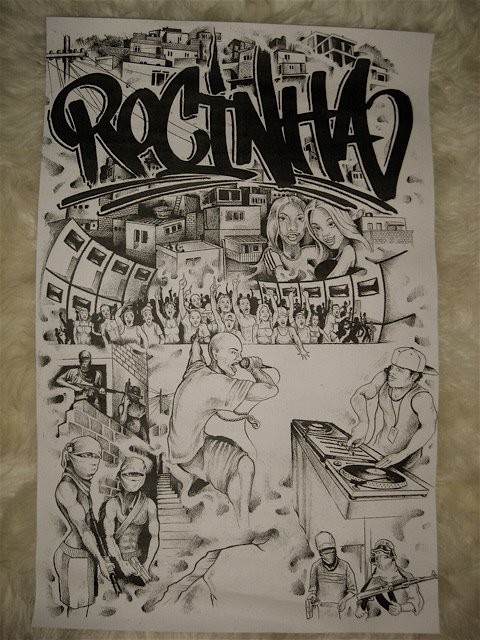
While we're all up on the Rocinha love right now, here, as a parting shot, is a fresh drawing from Zezinho DJ, a Rocinha resident studying music production in San Francisco. He's been very friendly & helpful to me re: all things funk ("o funk e minha vida" -- "funk is my life", as his motto goes), and clearly dreams often of his city on a hill and the sound that weaves it together.

Labels: , , , ,

Friday, July 28, 2006

"biggest cultural treasure we have right now"

Like I said, this has been a big week. While I can't underestimate the value of something as simple as having a contact in one of the favelas, as I do now with Rogerio and Dois Irmãos, the whole project was jumpstarted a few days ago when Maga Bo sent me what amounts to a rolodex of contacts in Rio. At this point, it's implied that any interview I conduct or person I meet or party I attend probably has something to do with that guy. (Although Reasoner deserves some points too.)

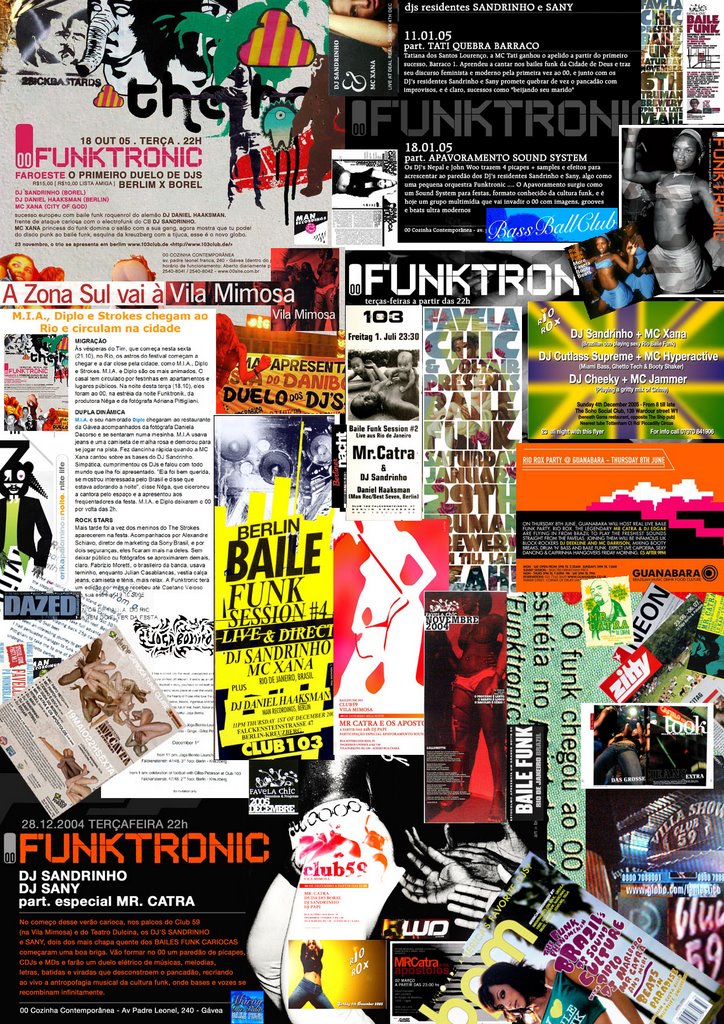
The first lead that has gone somewhere concrete was with Adriana Pittigiliani. She's an artist (esp. photography) and a booster of all things funk. As far as I can tell, she acts as something like a manager, or at the very least networks like one, and seems to have her fingers in all the major international promotions of funk (Diplo, Man Recordings) and is well-acquainted with the better-knowns locally (Mr Catra, DJ Sandrinho, DJ Sany Pitbull).


We had quite a long bate-papo ("chat" . . . has a distinctive enough word because Brazilians are known to chat and chat and chat . . . it took awhile to get out of there) about funk, favelas, and the Rio-US/Europe connection.

There's plenty of subtleties to be worked out in the ideas we discussed (Prof Sneed's thesis, which I've started, does a good job of that -- working on getting a link or permission to post the whole thing, & will certainly comment on it later), but a quick overview of the highlights:
  • Invisibility: The favelas are invisible to the society at large, natch (ever since Wayne used it in reference to my blog, I've been tempted to pick it up), despite being up close & next to them instead of banished to the periphery. What's the best way to make yourself known to your rich neighbors? Guns work. So does earth-shattering bass. (but the two go hand in hand, the thesis isn't called Machine Gun Voices for nothing.) It's giving me a sudden urge to read Invisible Man. Certainly it's a universal theme.
  • Ownership: Diplo was quoted in the April 2006 issue of BPM Magazine (afraid a link to the actual article is no where to be found, Adriana gave me a PDF of it) as saying:
    It's tricky because a lot of artists from the morros in Rio, they don't really think past next week. They do their shows, drop a funk track here and there, bust into a funk ball and get some respect and some girls and some paper, and thank the Lord they can live another month. They don't have contracts, endorsements and marketing plans like rappers got in the US -- they just got a little love from their neighborhoods -- and they feel dignified and that's fulfilling. So it's not going to be the street shit to blow up in the US. The artists just can't mesh with the music lifestyle and business like we see in the US.
She agree wholeheartedly with this, and railed against the fact that DJ Marlboro holds 100% rights to almost 4,000 funk tracks cut by local MCs for whom the short-term promise of several months rent is far more important than abstract notions like copyright. He then gets his name on the credits (his production, his DJ in the studio), plays them on his radio show (and apparently they're watered down versions anyway, more radio-friendly), and reaps any potential royalties. Want to make a funk compilation? Fat chance, Adriana tells me, as the Nossa Design guys figured out, since he's sitting on all of the best recordings.

It does make me wonder, though, how the Man Recordings comps got out and who's profiting from them. I'm all for freedom of exchange (the production & distribution of the music within Rio seems to be nothing if not fluid), and these facts do put in a better light the criticism of Diplo's funk mixes for not crediting the artists (better but not perfect -- whether or not it's a money thing, and whether or not the original "artist" by our standards can be found, he had to know a thing or two about them, but then again he's into the closely-guarded-secret thing, or so I'm told). However, if someone is going to profit from this stuff monetarily, it should somehow trickle down into the communities that created it in the first place.
  • Pastiche/Bricolage: That was ownership from the economic side, now let's get high-minded for a sec. Adriana is way into Roland Barthes -- I happen to think he's a pretty cool guy myself -- and together we vibed for a bit on the aesthetic of funk as a musical pastiche or bricolage (although the latter is of Lévi-Strauss coinage). I would say more of the latter than the former, however. Pastiche implies more parody or imitation, and a point that Adriana was insistent on is that you can't call funk simply some derivation of American hip-hop. Its Afro-Brazilian/Brazilian-Brazilian/is there much of a difference? roots & inspirations (capoeira, candomblé, samba, football) are not to be ignored. To that end, it's more a bricolage of musical styles, both local/national Brazilian ones and the imports of Euro-American cultural hegemony (cf the samples that made funk so popular up North in the first place: The Smiths, Tetris, The Clash, The Eurythmics, etc. etc.). That in turn makes it a distinctly postmodern musical form (this all relates to "Machine Gun Voices" -- I've already e-mailed to see if I can get permission to post it). But perhaps that bricolage is turning back over to pastiche? Part of the naive pleasure was that the older samples, as far as anyone could ascertain (or so Jace told me), probably came from black market bootleg tapes. As such, the DJs mashing them into funk tracks had no idea what kind of iconic status Morrisey carried to legions of kids who wanted to go out tonight but didn't have a stitch to wear. Now, as Adriana showed me, with Internet access readily enough available, a funk version of Madonna's "Hung Up" is being made in Rio, rather than by some bedroom DJ with a copy of FL studio and too much time on his hands. [desperate for mp3s, I know, she's giving me some next week.]
And so a quick overview turned into a much longer one. I have more to say (always, always), re: history and narratives, codes, porous borders, and all kinds of shit that's going to bore you and be a treasure trove for me when thesis time comes around. [speaking of treasure, those are of course her words in the title. in other words, samba is so 1955.]

One quick mp3 before I take a baile nap (would be a disco nap, but tonight I'm not going to a disco . . .) and prepare for my first foray into funk in the flesh. Here's a track by Mr. Catra, who's gravelly voice I figured made him the Mark E. Smith of funk. Adriana, however, says it's just that he shoots it to hell by performing at 3, 4, or even 5 shows a night. (and I thought I had misunderstood the Portuguese when his manager wrote me back and offered to have me accompany him to a night of shows.) Frenetic, that's just how they do it down here.

Mr Catra - "Mamada Safada"

Labels: , , ,

Friday, July 07, 2006

Introduction: Defining Terms

Beat n. Music.
A steady succession of units of rhythm.
The air is flush with beats, steady rhythms emanating from the headphones and stereos and soundsystems and synthesizers and mouths a whole world over. I like most of them that I come across, especially of the electronic variety. From head-nodding ambient sounds to four-to-the-floor bangers, I'm a beat omnivore, consuming beats wherever I find them. And, more importantly, wanting to know where they came from once they get in my greedy ears.

Diaspora n.
[when a group is] dispersed throughout other parts of the world, and the ensuing developments in their dispersal and culture.
A loaded word, to be sure. Both chosen for that reason and not. The original meaning is a little too biblical for my needs. The term as it is used in the context of "diaspora studies" (Google to get just about every displaced ethnicity under the sun) is certainly valid, but does demand a certain politicized history -- who initiated the diaspora, who suffered because of it? I'm not disputing the importance of such questions, and I know this use of the word will apply to some of the music and places about which I write.

However, I'm not sticking only to music produced by marginalized communities. As such, the open definition quoted above strikes me as the best for right now. An umbrella, big-tent definition: beats for all! A meritocracy of beats. As long as they sound good to me, whether it lead to just toe-tapping or all out ass-shaking, I get curious.

Where does the music come from and why? What kind of communities foster it? That's a grandiose question for ethnomusicologists to answer, but I will say as much: I'm convinced that urban spaces foster a particular kind of music (often electronic, often beat-based) that reflects and responds to the conditions of that space.

Intentionally vague, I know, but the blog is here to fill in the gaps.

With what? With funk, to start. I'm kicking this off seven floors up in Rio de Janeiro, Brasil. The national obsession may be on the sidelines in advance of Sunday's World Cup final and it may technically be winter (although the weather begs to differ, at least to my Northeast-hardened skin), but I'm gonna heat it up as best I can in my attempts to uncover the latest and freshest of Rio's homegrown hip-hop. Along the way, I hope to determine what influence, if any, its popularity up North as of the last couple years has had (you know, the kind of popularity that brought a gringo like me down here in the first place). How has the music changed? Its reception in Rio changed? And at the bailes where it all goes down in the first place?

We'll see where two months in a cidade maravilhosa can lead, with as much audio, video, pictures, and comment I can bring to the table.

[big ups of inspiration & encouragement to this class taught by this guy, as well as this associated crew and their ex-pat ex-cohort.]

Labels: , ,