Beat Diaspora: Beats, Buses, Bricks

an omnivorous take on music of the beat-based variety and the urban spaces that nurture it

Monday, December 01, 2008

Unfamiliar Sights

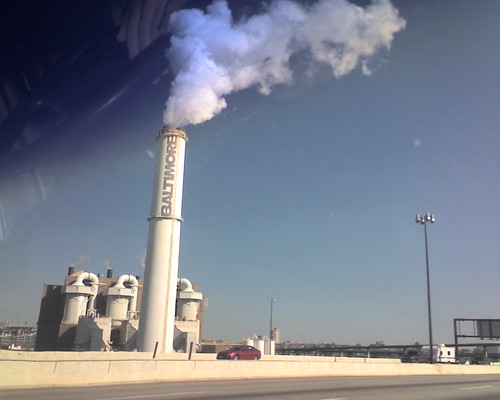
Holidays afford a routine return to familiar territory that is the perfect opportunity to change perspective. Countless times I have zoomed up I-95 -- the interstate highway, the ultimate American non-place [link via this excellent repository] -- and into Baltimore. I mark my entrance by that smoke stack, this solitary remnant of heavy industry on life support that is as much a cultural symbol of the city, a tourism board's welcome sign, as it the machinery of a factory.

Swooping over the Middle River and either branching off into downtown or continuing under the harbor, this elevated stretch of interchanges and off-ramps dazzles the eye. The water, the shipyard, the Key Bridge, the neighborhoods fanning out from downtown, and the city's modest skyline all compete for attention. It is a microcosm of the northeastern city, serving up a feast for hungry urban eyes.

But with the encroachment of non-places like I-95 that funnel in suburbanites, dumping them at the city's faux-historical economic engine, the Inner Harbor, comes the shadow of the highway trusses looming over forgotten neighborhoods. What haven't I seen in all those years of traveling into Baltimore by car?

I've given up on private car ownership, and when coming from outside the city now feel reluctant to bring a new private automobile into it. Call it moral congestion pricing. So on Friday, I parked at the edge of D.C. and took the Metro, taking advantage of late night weekend service. On Saturday, I took that game plan to Baltimore, hoping to take transit in a state notoriously hostile to it.

My M.O. was the Baltimore light rail, which snakes from BWI Airport and southern inner ring suburbs through downtown, heading north to its terminus at ex-shopping mall/current "town centre" Hunt Valley. I swore allegiance to the MBTA for four years, am doggedly loyal to SEPTA, and even keep subway porn on my coffee table, yet never have I taken Baltimore's tentative steps toward effective public transportation.

As the train crept north, I was particulary interested in seeing the vast hive of concrete and waterways around the Middle River from surface level. The trip did not disappoint, as I discovered two neighborhoods hidden in the shadow of I-95 and I-295. The first, Westport, is in fact cleaved by the latter highway. It is a tiny, down on its heels enclave of rowhouses, now poised for massive redevelopment by the light rail stop. A developer plans a giant high-rise complex with hotel rooms, office space, condos, and retail, which strikes me as a contrast of urban luxury and poverty of Mumbai proportions. While I certainly favor transit-oriented development, as this surely will force heavier usage of the light rail at its doorstep, I'm left with grave concerns about how such a development will interact with the existing neighborhood. Job training? Or the equally likely gated entrances, private security, and surveillance cameras? If there even is a neighborhood left, given the money that starts being put on the table to feed the "insatiable demand for homes on or near the water."


Eerie overtones of the Johns Hopkins hospital in East Baltimore, which looms like a citadel over the struggling neighborhoods at its feet. Town-[hospital] gown tensions run constantly.

Next stop: Cherry Hill. In another overlooked corner by those of us whose itineraries are circumscribed by highway routes, I found the nation's first planned community for African-Americans, designed to house WWII veterans. Sadly, it experienced rapid post-war disinvestment and decay, with the veterans' homes becoming public housing. But just across the water from Westport, the planners have come back as more waterfront property becomes enticing. An active neighborhood group ("A great neighborhood -- getting even better!) catalogues the ongoing development of the Cherry Hill master plan, which remains contentious in the community.

Later that night, I was listening to the Audio Infusion on WEAA. The DJ announced a caller from Cherry Hill and I smiled in recognition. The next morning, on the road in the I-95 morass, I craned my neck to catch a newly familiar sight, the stately Baltimore Rowing Club on the Middle River, with Cherry Hill fanning out behind it. New routes lead to new discoveries.

Labels: , , , ,

Monday, June 02, 2008

Who Says Vinyl is Dead?


Vinyl sales are up. Cycling is up. Public transit ridership is up. Nothing but good news today.

I've dusted off lots of vintage Chicago house and Detroit techno records for my farewell party tonight. Come by if life is thriving in the good life.

Labels: , , ,

Sunday, December 30, 2007

En Route


Where do you want to go today?


Winter in Zion, and I don't mean that Zionistically . . . Israeli reggae and thoughts on this complicated corner of the Middle East when I return. Roots and routes intertwined indeed.

Labels: , , ,

Saturday, August 18, 2007

Planet Sampa

This is what 11 million people looks like.

19 million if you count metro area.


But it could just as easily be 30, 40 million. The whole planet Earth. From up here, you doubt São Paulo ever ends.


Manhattan high-rises sprawling like Los Angeles County. NY vertical x LA horizontal. It's a terrifying equation.


I caught a winter cold in Buenos Aires last weekend, but haven't been able to shake it despite the balmy weather (I'm in the sub-sub-sub-tropics: the Tropic of Capricorn passes somewhere through the north side of the city, maybe 5-10 miles from where I am now). Could be that thick haze hanging above everything. 2:1 car to resident ratio.


A lazy stream of white pollution curling past the reflection of the midday sun on the River Tietê. It stank like some of the filthier parts of Rio I've had the misfortune of ending up in. They also happen to be the banks of the Universidade de São Paulo, considered to be possibly the best university in Latin America.

But that's Sampa for you. Flowers in the midst of the ruins.


The Municipal Theatre, headquarters of the Semana de Arte Moderna '22, a week-long spectacle that announced to Brazilian culture: modernism is here, it's here to stay, and its home is São Paulo. Cariocas will still say that if it doesn't happen in Rio, it doesn't happen (cf the names of their daily newspapers, O Globo and O Jornal do Brasil). But the truth of the matter is that SP is the country's cultural engine (&economic, &industrial, &demographic, &well the list goes on). It's now home to São Paulo Fashion Week and the São Paulo Art Biennial is the second longest-running in the world next to Venice. Rio's enduring tourist mythology may make it the prime candidate for hosting sports events, but the truth of the matter, as much of a Rio partisan as I am, São Paulo breathes Brazilian modernity and visions of the future. This is a city where buildings that date from the 1950s are considered old. Where there are still cranes wedging more construction into already dense areas.


Where the trains still run: the rail infrastructure in Brazil collapsed under the dictatorship, but the Estado de São Paulo still holds theirs together (any & all public transportation always in desperate need here).


Legendary traffic. Once a week, depending on your license plate, you're prohibited from driving. City choked (poisoned? depends who you ask) with cars & people. No wonder the highest per capita helicopter fleet in the world. Skimming the treetops of fear. City of Brazilian zeitgeist: modernism--futurism--hedonism? But always driven by fear. The Brazilian future of the world.

Voices bubbling up from the outskirts. The dreaded "periferia." Racionais MCs -- to speak out is to serve as the voice of reason. Give the helicopter&gates crowd something else to fear.

Racionais MCs - Pânico na Zona Sul


Sparse production, just a running funky bass line. "Justiceiros são chamados por eles mesmos / Matam humilham e dão tiros a esmo / E a polícia não demonstra sequer vontade (Hired killers as they call themselves / Kill, humiliate, and shoot at random / And the police doesn't show any will to stop them)." Guess who opened for Public Enemy when they came to São Paulo?

Labels: , , , , ,

Tuesday, July 18, 2006

A Fortnight In: Rio -- Riotous


Rio is riotous. It grows everywhere. Flora erupts out of every crevice, and likewise people. The favelas, thanks to Rio's jarring juxtaposition of topography, are always proximal. Even if the social reality means that rich and poor, flatlander ("da asfalta") and hill-dweller ("do morro"), are worlds apart, they never are spatially, which makes the inequity all that much harder to ignore. A quick drive through town, especially via highway, and you'll spot the familiar outcropping of corrugated roof buildings, the daring architecture of making-do. From the incredible vantage points of the city's landmarks, Corcovador (site of the famous statue of Cristo Redentor, which I felt obliged to snap) and Pao de Açucar (Sugarloaf Mountain), it's easy to get mesmerized by the beaches, the ocean, Maracana, and the upward thrust of the city's lateral sprawl. But pay closer attention and you'll spot 20-35% (estimates vary) of the city's population precariously nestled on every spare hillside (even on the way up to Corcovar, where the train passes Morro do Ingles, Englishman's Hill).

A asfalta, too, is fascinating, a vibrant display of creativity in what is clearly a city with a hands-off government, at least when it comes to zoning (policing is another matter). Lanchonetes (snack bar counters) dot nearly every corner, even in posh neighborhoods. Street vendors well set up a table anywhere they like, from the sidewalk along the entrance to PUC-Rio, where I'm currently taking classes, to an absurdly long line outside of a club, offering partygoers the chance to drink outside and save a few bucks.

The buses, in particular, are a marvel to behold. Used to the monopoly of the MBTA, I was shocked that Metro Rio has competitors. Hell, in my neighborhood, where the actual subway doesn't even reach, Metro Rio hardly accounts for 5% of the buses I see. Instead, it's a flurry of different companies & prices, the number stew of bus routes, a placard in the window with a quick run-down of neighborhood stops. At certain times of day on Avenida Adaulfo de Paiva, which runs right below my window, there are far more buses than cars. And then there are the vans, which pull up alongside any cluster of people (actual bus stops, while extant, are by no means necessary -- simply hailing a bus as you would a taxi is typical), slide open the door, shout out a list of destinations, load any takers, and keep moving. Red lights, I might add, are merely a suggestion.

Riotous. Policeman carrying assault rifles and wearing flak jackets. Nothing like an AR-15 to wake you from an early morning daze.

Riotous. At night I stroll the praia de Leblon, populated after the beachgoers leave by runners & lovers. As late as ten, I've seen a girl's soccer camp in full swing. Returning to my host's apartment, the favela Vidigal looms large, ablaze with lights and looking for all the world like it will slide off into the ocean.

Riotous. I sleep with the windows open, city sounds I know & love punctuated by staccato bursts. Firecrackers or gunshots? I can't yet tell the difference.

Labels: , , ,