Beat Diaspora: Beats, Buses, Bricks

an omnivorous take on music of the beat-based variety and the urban spaces that nurture it

Monday, December 01, 2008

Unfamiliar Sights

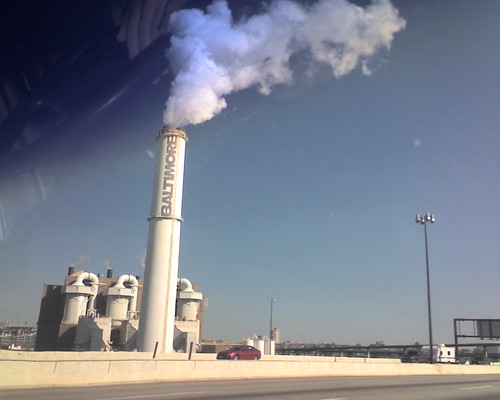
Holidays afford a routine return to familiar territory that is the perfect opportunity to change perspective. Countless times I have zoomed up I-95 -- the interstate highway, the ultimate American non-place [link via this excellent repository] -- and into Baltimore. I mark my entrance by that smoke stack, this solitary remnant of heavy industry on life support that is as much a cultural symbol of the city, a tourism board's welcome sign, as it the machinery of a factory.

Swooping over the Middle River and either branching off into downtown or continuing under the harbor, this elevated stretch of interchanges and off-ramps dazzles the eye. The water, the shipyard, the Key Bridge, the neighborhoods fanning out from downtown, and the city's modest skyline all compete for attention. It is a microcosm of the northeastern city, serving up a feast for hungry urban eyes.

But with the encroachment of non-places like I-95 that funnel in suburbanites, dumping them at the city's faux-historical economic engine, the Inner Harbor, comes the shadow of the highway trusses looming over forgotten neighborhoods. What haven't I seen in all those years of traveling into Baltimore by car?

I've given up on private car ownership, and when coming from outside the city now feel reluctant to bring a new private automobile into it. Call it moral congestion pricing. So on Friday, I parked at the edge of D.C. and took the Metro, taking advantage of late night weekend service. On Saturday, I took that game plan to Baltimore, hoping to take transit in a state notoriously hostile to it.

My M.O. was the Baltimore light rail, which snakes from BWI Airport and southern inner ring suburbs through downtown, heading north to its terminus at ex-shopping mall/current "town centre" Hunt Valley. I swore allegiance to the MBTA for four years, am doggedly loyal to SEPTA, and even keep subway porn on my coffee table, yet never have I taken Baltimore's tentative steps toward effective public transportation.

As the train crept north, I was particulary interested in seeing the vast hive of concrete and waterways around the Middle River from surface level. The trip did not disappoint, as I discovered two neighborhoods hidden in the shadow of I-95 and I-295. The first, Westport, is in fact cleaved by the latter highway. It is a tiny, down on its heels enclave of rowhouses, now poised for massive redevelopment by the light rail stop. A developer plans a giant high-rise complex with hotel rooms, office space, condos, and retail, which strikes me as a contrast of urban luxury and poverty of Mumbai proportions. While I certainly favor transit-oriented development, as this surely will force heavier usage of the light rail at its doorstep, I'm left with grave concerns about how such a development will interact with the existing neighborhood. Job training? Or the equally likely gated entrances, private security, and surveillance cameras? If there even is a neighborhood left, given the money that starts being put on the table to feed the "insatiable demand for homes on or near the water."


Eerie overtones of the Johns Hopkins hospital in East Baltimore, which looms like a citadel over the struggling neighborhoods at its feet. Town-[hospital] gown tensions run constantly.

Next stop: Cherry Hill. In another overlooked corner by those of us whose itineraries are circumscribed by highway routes, I found the nation's first planned community for African-Americans, designed to house WWII veterans. Sadly, it experienced rapid post-war disinvestment and decay, with the veterans' homes becoming public housing. But just across the water from Westport, the planners have come back as more waterfront property becomes enticing. An active neighborhood group ("A great neighborhood -- getting even better!) catalogues the ongoing development of the Cherry Hill master plan, which remains contentious in the community.

Later that night, I was listening to the Audio Infusion on WEAA. The DJ announced a caller from Cherry Hill and I smiled in recognition. The next morning, on the road in the I-95 morass, I craned my neck to catch a newly familiar sight, the stately Baltimore Rowing Club on the Middle River, with Cherry Hill fanning out behind it. New routes lead to new discoveries.

Labels: , , , ,

Monday, November 17, 2008

Returns

O Cabidão caught an overnight flight to Rio on Saturday, rather gladly saying farewell to the U.S. and returning to "a minha terra, o meu Brasil!" Too cold, volume too low, clubs too small (and my basement not the nicest place to live either, granted). After three weeks as the ad-hoc tour manager of the first non-Marlboro DJ to play for American audiences, I now have a more realistic perspective on the viability of bridging the divide between global ghettotechnicians and their northern fans, at least in the case of funk carioca, really completing the circle from wide-eyed onlooker to direct intervener.

I don't want to declare the tour a failure. There were plenty of highlights: Global Frequency, MoFo Radio, Invasores do Baixo, Mudd Up!, TTL in-store, Batida do Funk. And the tour really brought out the best of some fine folks like wayne&wax, Lone Wolf, DJ Ghostdad, and DJ Comrade, all of whom put their time/money/effort/talent into collaborating. Kosta of Bananas even used his west coast contacts to score a show in Seattle on three days notice.

Still, a tour remains an economic proposition, and one that fell fairly flat. It seems that playing the Brazuca circuit (Hyannis, Newark, Bridgeport, Boston, etc.) pays for the plane ticket and is a prerequisite to being able to afford other shows for the knowing gringos. Unfortunately, this means Brazuca crowds will also be driving who gets brought up. Most are not carioca, but from other, poorer states in Brazil, and get their funkeiro fandom from the web, where heartthrobs like Mulher Melancia (the Watermelon Lady) are the top draw. Cabide, in fact, was a relative unknown, so he didn't bring out the Brazilians en masse in New England.

While this tour was a half-and-half proposition, in the future I expect funk DJs and MCs to mostly play for the brasileiros and then, if possible, an interested party like myself, the Boston Bouncers, Xão Productions, or Masala (who had expressed interest, but we had some visa issues) will cobble something together.

The "Batida do Funk" party by Xão at S.O.B.'s was, admittedly, my favorite of the tour. To trot out an old cliche, in the melting pot of New York we were able to find the mixture of gringos in the know, global music aficionados, and plain old Brazilians to make the show a real crossover audience. The addition of Brazilian dancers and a baile funk slideshow by Vincent Rosenblatt of Agência Olhares made for an odd refraction.


Dancers juxtaposed with the image of dancers. A baile funk americano (Cabide repeatedly referred to shows as "bailes") juxtaposed with a baile funk carioca. We were both interviewed for the upcoming film Beyond Ipanema, about Brazilian music in the U.S., whose directors were in the audience. I was unable to tell who was Brazilian and who was American. It's difficult math when a club that serves $10 caipirinhas can't pay the DJ as much as a favela in Rio can, but that's the strange inversion for you. Who mediates, who performs, who speaks (Cabide was mute without English and I was left to translate for film, radio, conversation). He opened for Diplo on the penultimate show of the Mad Decent tour, playing the first set even before some indie band from Brooklyn came on. The headliner later worked in a tamborzão, but he was temporally separated as much as possible from the real performer. Worried about being upstaged the next night, cutting the volume, sucking the life out of the music. Metaphor and fact. Who controls and who performs. The tours are over, but the film will linger.

Labels: , , , , , , ,

Monday, June 16, 2008

Heat Waves


The mercury kept climbing and summer doesn't even start until next week. I'm out of Boston for the foreseeable future and have moved to the muggier confines of the mid-Atlantic. On the train heading north last week, I saw hydrants wrenched open in East Baltimore, the classic cooling strategy on scorched city streets. The Johns Hopkins Medical Complex looms over the blocks and blocks of row houses in that part of the city, a citadel of air conditioning towering above the sweltering fields of asphalt.

In D.C., they kept turning on the hydrants till they bled the taps dry. "Quander-Collins said some residents complained that as soon as WASA employees arrived to close a hydrant, neighbors would return and open it again. Deborah Boseman of the 900 block of Barnaby St. SE had been without water for almost six hours. 'This doesn't make any sense,' she said."

The heat makes you do crazy things.

/rupture's got an early mix of the summer candidate, but damned if I don't keep coming back to La Ola de Calor from last year. Summer is all about memories anyway, right?

Labels: , , ,

Saturday, December 16, 2006

Remix Politix


On the left: DJ Technics, an originator in the bmore club game. On the right: Sany DJ, an originator in the Rio funk game. A similar enough stature in their respective genres, and a remarkably similar recent trend: taking the music places it hasn't been before.

A little over a month ago, Technics alerted the Hollerboard to some golden new remixes -- still available for d/l on his site -- to much acclaim. Mostly recent hip-hop: quick fixes on Beyonce (w/ and w/out Jay-Z), the new Ciara single, Rick Ross gets tweaked another go around, dusts off an old 2Pac track. But one sticks out like a sore thumb.

Radiohead - Everything In Its Right Place (DJ Technics Remix)

It's gotten mostly rave reviews, cropping up in mixes all over the place, and Technics himself affirms that it's among his favorites of his recent tracks. But at first glance, it seems like something you'd expect from a dude who spends too much time on music blogs, knows his way around a copy of Reason, and likes the irony of applying an aesthetic from black Baltimore to white indie kid music.

Technics explains in the thread, "i'm trying to breath new air into the style of track making....ya know messin wit shit that folks wouldnt even touch." And in the initial post writes, "I BEEN BUSY TAKING MY SHIP BACK."

The sound definitely is something new -- it's much sparser and more minimal, even a little slower (it's Radiohead after all) than the club music I'm used to hearing -- as is the source material. I certainly can't fault the originator for originating, but it still strikes me as a noteworthy phenomenon. To overtake the upstarts, whose West Baltimore roots don't go quite as deep (and for whom the grab bag of other sounds comes more easily), you've gotta branch out.

Then again, the roots of it have been in the works for awhile, as the Baltimore City Paper reported earlier this year. As far back as 2003, club DJs were invited to play parties in NYC and Hollertronix helped blow it up via live gigs and white labels. So slowly the local crews got a clue. Scottie B: "I didn’t have any idea. We knew they were into it in Philly, in the black crowds, but we didn’t know anything about any white crowds anywhere."

And with a new audience you've gotta appeal to them, right?

Sany DJ rolled through Europe last month. Not the first Rio DJ to do that, but one of the few certainly. I saw him at Favela Chic (a questionable name, but a critical mass of Brazilians work there [including the owner] and they bring in some legit Brasileiros to play from time to time. then again, would I feel comfortable opening a bar called Ghetto Chic abroad?), where he dropped the Madonna "Hung Up" remix I commented on over the summer and posted more recently.

While funk has been celebrated for its blender-like aesthetic, from my experience it's less wide-ranging than we think. A lot of folks were hyped up on hearing The Smiths or The Clash with Portuguese rapping overtop, or the more general formulation "punk rock + new wave samples + little kids screaming + miami bass + outsider music industry = most exciting thing going on right now". Call it the unintended Radiohead remix.

But I've listened to a ton of funk this year, and the punk/new wave sound is definitely in the minority. From what I can tell, it had its hey-day in the late '90s, the era of the Bondes ('crews', roughly, like Bonde do Vinho, who did the "Rock the Casbah" cover). In the present day, however, DJs and MCs are a lot more cognizant of who they're imitating and what they're sampling. "Hip-Hop Radio Traxx" was one of the most popular pirated CDs available in Rio, carrying the most recent commercial rap. Nobody was interested in if I knew who The Strokes were, they were more keen on my knowledge of 50 Cent (or "Cinquenta Centavos"). Indie rock had its place -- A Maldita ["The Damned"] at Casa de Matriz was very much au courant -- but in an environment far removed (culturally) from the baile funk.

So did Sany remix Madonna with an eye toward the world beyond Rio? Probably. But is that a bad thing? Not necessarily. I've highlighted before his new, more avant-garde style, which he can't play at traditional bailes becuase the crowd's not ready for it yet.

I can't speak as knowledgably about Technics & Bmore, even if I do have the Maryland connection that the City Paper vaunts (but don't give me & Roxy -- Columbia, Howard County raised -- too much cred: Naymond and Mike, city kids in The Wire, argue this season whether the KKK exists in HoCo). Sonically, at least, compare the recent cuts to /rupture's archieved piece from '96 and you'll hear the difference. The newer stuff is, I think, more cerebral, especially the killer choice of the 2Pac vox-cum-manifesto. Maybe the new audience is liberating for some creative ideas that were thus far suppressed. Ditto for Sany. The ass gets tired of shaking and the head wants to enjoy it some more. Of course the music's going to evolve -- none of these sounds are or ever were static -- but the question is with an influence from where and toward what?

Am I hinting at a certain disapproval of these styles being plucked out of their "natural habitat" (or "local scene", for a less objectifying terminology), a process that I myself am implicated in (like I said, don't give us suburbanites too much cred -- Bmore club was news to me too)? Maybe just some caution.

"The only people that are concerned about outsiders are the real outsiders," Aaron LaCrate comments in the City Paper piece.

In club, perhaps it's less of a concern. It's not too hard to get a Bmore DJ or MC up to NYC for a show and have him or her return to Charm City with some extra scratch. The long-time players are playing out, selling records, getting press, and obviously don't mind sharing the trade secrets: Fork out for Technics' Club Tools and let's hear your remix. But Mr Catra, the biggest MC in Rio, doesn't think he can get a visa to play in the U.S., so we end up with a Bonde do Role tour instead.

I've avoided the 'a' word -- authenticity -- thus far, but man those kids just don't have it. The sound simply doesn't come natural to art school students from middle-class Curitiba, nowhere near Rio. It's self-aware enough to appeal to Americans and European -- and hey, they're Brazilian, that's enough caché for an unaware audience up North -- but doubtful any bailes in the carioca hills. To bring it full circle: It's the equivalent of me starting a Baltmore club crew.

Yet Sany loves Mariana's vocals and isn't he the best judge? Muito complicado, muito.

Labels: , , , ,