Beat Diaspora: Beats, Buses, Bricks

an omnivorous take on music of the beat-based variety and the urban spaces that nurture it

Friday, October 17, 2008

From Nation to the Nationals

It's not month-long indigestion from too many half-smokes that has rendered me silent on the blogafront. Just a recent move to Philly -- more coming shortly -- from which I haven't shaken the disorder yet. But I'd still like to provide a coda to my stay on the homefront in and around D.C. The last couple months have been a bonanza of momentous baseball, from the curtain call at Yankees Stadium to the Fightin' Phils fall classic hopes to Thursday night's Fenway epic and tonight's do-or-die conclusion.


Lost in October magic, however, is the relative ignominy of the Washington Nationals catastrophic 100+ loss season, coupled with the worst attendance in a new ballpark ever. There are ugly internal disputes with owners the Lerner family, which have spilled over into the worst crime off the field: deadbeat tenants. The Nationals have refused to pay $3.5 million in rent to the D.C. city government, claiming that the taxpayer-funded ballpark was substantially incomplete by opening day and continues to need a lot of work. The Lerners are thumbing their nose and neglecting their role as the anchors of the massive plan to redevelop the Anacostia waterfront, long the neglected waterway of Washington and an afterthought to Potomac symbolism. The ultimate goal is to integrate the Anacostia waterfront, and by extension the largely poor and black neighborhoods that lie along and especially east of it, with the rest of the wealth and vibrancy of D.C. The stadium, meanwhile, was supposed to be a crucial litmus test of whether such development could be done without displacement and disregard for surrounding neighborhoods. Withholding an already cash-strapped city -- whose previous mayor expended the last of his political capital to get the stadium through the city council -- of millions of dollars in rent does not make for a good neighbor. And more to the point, their claims are simply untrue.

I was at opening day on a chilly night at the end of March, attended games throughout the summer, and even had tickets to the rained out final home game of the season. From a fan's perspective -- and the perspective that should matter, because it's ticket revenue with which the organization should be paying that rent -- the stadium is more than complete.

Without getting lost in those minutiae, however, I want to return to opening night and the very fact of that stadium. The mechanisms of urban redevelopment, high-powered private developers, and an economic engine as powerfull as Major League Baseball were a perfect storm. Granted, there was much wrangling for several years over whether the city would approve a stadium with public monies when many of the fans would be coming from neighboring Maryland or Virginia -- states whose jurisdictions were not contributing. But MLB made it clear that no stadium meant no team, which pro-business mayor Anthony Williams could never have let happen, especially when Northern Virginia way vying to host the team out in the suburbs.

Contentious city politics aside, the stadium was assured, the team came to Washington (as the Nationals, not the Senators, their previous incarnation, because D.C. has no senators), the Nats played three seasons at RFK Stadium, and then Nationals Park arrived this year. As a baseball fan whose father can remember attending Senators games at RFK, I was actually rather fond of the old retro spaceship down East Capitol Street. But as a comparison between old and new points out, Nationals Park was likely to follow the generic lead of casino ballparks that suck away your dollars and sprawl over far more land than charming 8-acre postage stamps like Fenway or Wrigley.


For opening night heroics, I admit you can't beat the president throwing out the ceremonial first pitch -- politics aside, a Washington tradition that dates back decades -- and the star of the team winning it in the 9th with a walk-off home run.

But when the dazzle fades and I extract my sentiments from the matter, there is still a hard critique to be made, both architecturally and from an urban planning perspective. The Post's architecture critic definitely took the stadium to task, sounding a dissenting note on the front page of the Style section the next morning while the rest of the paper trumpeted the new ballpark. Philip Kennicott's conclusion is worth quoting at length:

From the top of the stadium, look out at the skyline, toward the Capitol Dome. At first, it seems like a happy accident that it is most visible from the cheapest seats. But now look down into the neighborhoods where public schools have become dilapidated brick bunkers, their windows covered in forbidding metal mesh. It's enough to make you weep. Not about the stadium, which is as generic as it goes. But rather the cynical pragmatism that governs our priorities, socially and architecturally. Washington is a city where people can stare straight at the most powerful symbol of their democratic enfranchisement, and still feel absolutely powerless to change the course of our winner-takes-all society.

And it didn't have to be this way. It's not just a matter of misplaced priorities, which we can all argue about. It's also a matter of inept bargaining and bad planning.

"The city had Major League Baseball over a barrel if they wanted, because baseball had nowhere else to put the team," says Neil DeMause, co-author of "Field of Schemes," a look at the economics and politics of baseball. DeMause argues that Washington got one of the worst deals in recent history when it lured the Nationals here.

If the stadium sparks economic development in the newly revitalized South Capitol neighborhood, perhaps the fact that the city got hosed will be forgotten. But the architecture will remain, and it will remain mediocre. That failure isn't just a matter of bad negotiating on the city's part, or bland aesthetics on the part of HOK Sport, the architecture giant that designed the rush-job Nationals Park.

It is also a colossal symbolic failure with national and international import. At a time when the United States is losing a global argument about freedom and democracy, when China and countries along the Persian Gulf are proving to an attentive developing world that top-down leadership is the best and most efficient route to prosperity, the capital of the so-called free world built a monument to its national pastime that gets a C-plus.

It passes, barely. But as sports lovers know, sports is never just sports. And architecture, especially in a world capital, is never just architecture. Nationals Park might be a better experience than RFK, but it fails to say anything larger to the city, or the world.


I find a similarly uninspiring lack of vision in what surrounds the ballpark, what came before it, and what semiotic messages are on display inside of it. While I applaud the city and the team's massive and successful PR campaign to get fans to ride Metro, the carefully managed block from the Navy Yard metro station to the ballpark entrance exudes a shopping mall feel.

Construction cranes loom over the horizon as the redevelopment initiative is in full swing, while street-level banner ads promise a new Half Street, turning a city block into a product to be delivered on a timeline. Half Street SE is not "coming 2009"; it has been there for as long as the grid has been there. But "half street. the whole experience." isn't so much a city block as it is a combined retail/luxury housing/office space theme park. After being shuttled along Half Street from the Metro into the ballpark, you are greeted by some even more perplexing advertisements:


As the rise of this new neighborhood is on display all around you, advertisers are encouraging you to leave the city entirely and go to shopping malls in Maryland and Virginia like White Flint or Dulles Town Center. It begs the question if the neighborhood -- what developers want to call the "Ballpark District" while the city insists on "Capitol Riverfront District" -- has more in common with its suburban counterparts than the nearby neighborhoods in the city itself.

Ultimately, I'm not expressing disdain at the prospect of luxury retail and condos, but at the fabrication of a neighborhood that may never even become a neighborhood. The "district" appelation is already an indicator and the distinction between the two names is telling. The developers are focusing on the cash cow, the structure on which they've economically hedged their bets but also the marketing tool that makes it attractive to their target audience. The city hasn't given up on the idea of a larger Anacostia redevelopment initiative, but that name remains a dirty word. I distinctly recall eavesdropping on a conversation at Nationals Park, where two attendees shuddered at the prospect of going one stop too far on the Green Line past the Navy Yard and ending up in the neighborhood of Anacostia, on the other side of the river, as though they wouldn't even be safe on the subway platform. Growing up, the green line was the "dangerous line." Anacostia's image problem is so bad that even the Metro line that serves it is considered suspect by white suburbanites. Consequently, developers are reluctant to associate their new district, which has far more in common with shopping malls 20-30 miles away, with neighborhoods less than a mile away.

West of the ballpark, across South Capitol Street, one wonders how the hulking behemoth next door has affected both the quality of life and property values/taxes of Southwest D.C., what the Washington City Paper is cheekily calling the Nats Flats while still leveling the straight dope on the history and prospects of the neighborhood, perhaps most notable for its mid-century modern urban renewal architecture. It may be the victim of urban renewal round two, as some housing projects have already been demolished, but I still think that stadium boosters are hoping South Capitol Street will remain a border between rather than a boulevard connecting two vastly different neighborhoods.

Meanwhile, the sides of the ballpark closest to the river recall the area's industrial past. The era of residential urban renewal is, one can hope, largely a thing of the past. No neighborhoods were decimated to make way for Nationals Park. Government Center, it ain't. But what remains -- a sewer pumping station and a cement factory -- occupy prime real estate, much to the stadium boosters' embarrassment.


The WASA pumping station is, I admit, a purely functional part of the city's infrastructure that could probably be moved elsewhere, but after capturing this shot of the cement factory between Nationals Park and the Anacostia River, I became increasingly fond of it. The Potomac may be the river of political power, where the presidential yacht plies the waters, but the Anacostia is a blue-collar river, a river that works. In the meantime, Half Street will continue to funnel fans directly from the Metro and into the ballpark's main entrance facing away from the Anacostia -- although there are still prominent entrances on both the pumping station and riverfront sides of the ballpark.

Most journalists were dismissive of the area prior to the arrival of the stadium. The New York Times takes the consensus view in its opening day story: "But everyone agrees that the change in the neighborhood in the 22 months since work began on the 41,000-seat stadium has been astounding. In what was an urban wasteland of trash-strewn lots, sex clubs, and taxi and auto repair shops, developers have invested in new offices, condominiums, rental apartments, stores and restaurants."

With such a scathing description -- "urban wasteland" -- it would seem hard to argue with redevelopment of any kind. But at the same time, I began receiving e-mails in the summer of 2006 about the imminent closure of Nation Nightclub, a D.C. mainstay of the electronic music scene, and arguably the incubator of house in the nation's capital as host to the Buzz parties. I didn't put two and two together, until I realized that the "urban wasteland" everyone was so excited to raze included Nation.

At that point, the construction of a stadium claimed a real casualty. Baseball may have deeper pockets and a wider fan base than house, but it's worth staking out the loss of such an institution. D.C. has a hard enough time establishing a unique urban identity, and the Buzz parties, while following the same national rave arc of underground to mainstream to oversaturated drug haven, was still the fulcrum of a local scene.

Just as my night out at the Paradox conjured up Baltimore Fever memories, the other half was down the BW Parkway in D.C., with Scott Henry at the helm. Hopefully musical metadata can hold the memories where bulldozers have already claimed the physical space.

A mix is the monument: A dancefloor once stood in the outfield.

Labels: , , , , , ,

Wednesday, August 20, 2008

Brazilian Rhythms: Distrito de Columbia


Join me and DJ Neville C, proprietor of Som Records, a crate digger's mecca, for a night of, well, Brazilian rhythms. Expect samba & variations, tropicalia, MPB of all stripes, batucada, hip-hop brasileiro, and of course funk carioca.
Cafe Saint-Ex is at 14th and T Streets, D.C. No cover, so vem todo mundo.
[p.s. Post #100!]

Labels: , ,

Tuesday, August 19, 2008

Pictures don't need metaphors and neither does Go-Go

50th Anniversary of The Pick of the Week: A Self Critique
~By Thomas Sayers Ellis

That joaint, especially, the title is kinda 'fusing. I mean confusing.

What you trying to say and why don't you just take pictures and shut the fuck up G.

You worse than Mambo Sauce.

Where's your photo book.

Where's your CD.

You should do like the rappers.

You should do like SharpShot and come by and photograph me and my kids and shut the fuck up.


Pictures ain't News.

Pictures don't need metaphors and neither does Go-Go.

TMOTT was cool as shit till you start dropping visual weekly-reader critiques on the scene.

I'mma steal your camera when I see you.

Still I be lookin' forward to these jammies and want to make a contribution to The Go-Go Pick of the Week fund
so you can start a Photographers Collective to show us how beautiful and how ugly we is all at once.

Where do I send the check? Sike move, fool.

I like this week's Pick. Looks like the kid is floating by on a skateboard.
w h a t the? He is. Damn and he looks like a young Barack too.

I imagine it must take a lot of luck and balls to walk around SE pressing people to take their photo
and bugging peeps for old Go-Go posters that you never get.

My dude don't quit. I seent some of your flicks on a Suttle DVD.

You must have gotten paid for that, cause I, myself purchased four.

Know what? The Pick of the Week is 50 weeks old this week, dayum, a milestone!

Where's the party.

Can I get a few flicks of Model Chick for my dashboard. I know you gots some.

If you had a nickel for every time someone thank you for a Pic, you might have a quarter, might.

That ain't now real job, flashing people while they danicng and shit.

Mr. G ought to kick yo a s s. Get off the stage nucca.

They say you talk to yourself when you shoot.

They say you hear the snare play before it plays.

They say you take pics just to get in free.

That you just using Go-Go to get a job at Jet.

Was that you coming out of the Metro in plaid on plain in Anacostia? You need a break dude.

Happy 50th young...


Labels: , ,

Wednesday, August 13, 2008

Go-Go Photo


If you're looking for go-go, hip-hop, and R&B in the DMV (that's District, Maryland, & Virginia to you), then look no further than Take Me Out To The Go-Go. It's a one-stop shop that's been flooding my inbox lately with multiple daily e-flyers, mixtape announcements, and something that really caught my eye: TSE's pick of the week photo. TSE is Thomas Sayers Ellis, a photographer and poet. He's a co-founder of The Dark Room Collective, which has its roots in my recent stomping grounds up in Cambridge. In fact, I believe their Victorian HQ was around the corner from where I lived this year.

He's now working on a book of photography, The Go-Go Book: People in the Pocket in Washington, D.C. If the TMOTTGG pick of the week is any indication, he's captured a very rich slice of life in our nation's capital. And he writes a mean poem to boot --

The Return of COLORED ONLY

One of these badass,
glorious days,
the signs and negative sounds
that worked against us

will all begin their tenures
of service, their holy and complex repentance.
It has already begun with
"Nigger" and "Bitch"
and for this we have young folks to thank,
their disrespect and fearlessness.

Naturally, this will scare
the civil rights out of some
and, for a mad-moment, empower
a great many wrong-cultured others.

To this "The Return..."
will either code switch or hood ornament,
drama-drumming both––a cult-nats matrimony
of the vernacular re-mix: ain’t studin’ you,
nommo no more nommo,
stop studin’ us.

All yall who tell yall hearts Art,
your Bama Hour is, again, up-struggling
as we (credits and debits alike)
hang and unhang the old slanders ourselves

--not as segregationists
(although that wouldn’t be
that bad, given...) and not as Air Februarians
(.., given…) but as identity repair-people,
faders of trick moves, trope-a-dopes
and okey dokes,

laying our dice down like ( ) we love us.


Labels: , , ,

Thursday, August 07, 2008

Trinidad Nights


I've closely followed coverage over the last couple months of the spate of violence in the D.C. neighborhood of Trinidad, which has ultimately resulted in two separate cases of the police setting up checkpoints and only letting in residents or those with documented business. I think of D.C. as a city in and of itself before adding in the federal government (whereas for most Americans its identity is exclusively the government), so I will set aside the obvious absurdity of checkpoints all of two miles from the Capitol, which was enough to ensure it international coverage. It is nonetheless a tragic breakdown of civic life when such a measure is deemed necessary -- and done without community consultation, I should add. Checkpoints are precisely the mechanism of urban segregation, stigma, and ghettoization. "Several years ago, Richardson said, she removed the steel grate from her center's front doors, and she plans on taking the bars off the windows. The checkpoint, she said, was infuriating because it suggested Trinidad has not changed." I can remember from my own experience in Rocinha the startling sensation of entrapment during a police invasion.


The outcry was widespread, and the legal challenges came quickly to reverse the status of "occupied Trinidad." While a Post editorial asks why there was more protest over the checkpoints than the murders, I can point to some compelling community efforts to the contrary, notably a mock burial for snitching led by the venerable D.C. anti-violence group Peaceoholics.

WAMU, the D.C. NPR affiliate, also ran a story on another anti-violence event (audio for RealPlayer & Windows Media), where go-go beats hover in the background as soon as it opens. It featured Anwan Glover, better known to many outside of D.C. as Slim Charles. In D.C., though, he's better known as Big G of go-go legends Backyard Band, credited with bringing more of a hardcore rap style to the go-go scene.


"Keep It Gangsta," if that gives you any idea.


Holding it down in Southeast D.C., very much the heartland for go-go. Audio is kind of rough, but the home movie feel is definitely charming. Now though, Big G is using his clout, the kind that only a go-go star who used to be a banger can bring to young black D.C., to bring home the message for D.C. neighborhoods that violence has got to go. Music is a way out of violence -- it was for Big G and it is for some of the kids interviewed in the story.

The GoTube commentators have it too. As TnUt00bLvr writes: "I'm with you for real, then niggas wonder why they gots to go all the way to Va.& Wheaton to see them play?STOP beefin in the local spots then y'all can party with Back!!You just taking GoGo farther & farther away from HOME because of bullshit!! Quit reppin hoods you rentin' or live with your folks in man!!" Inner-city violence is definitely another factor in the suburban dissemination of go-go.

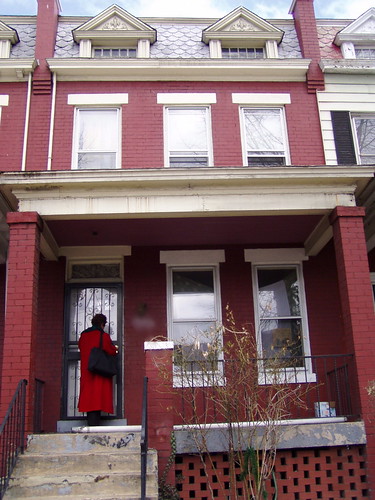
The WAMU story is particularly penetrating for me, though, because of the comments by John Roman of the Urban Institute. He delves into the economics of the drug trade and then segues to a geographical analysis of how the neighborhood functions in the wider urban network: "At first, it's hard to see how this tiny neighborhood of brick row houses with wooden porches could be home for such violence. Bordered on one end by Gallaudet University and the other end by the National Arboretum, Trinidad physically lives up to its billing as a garden community. But as Roman observes, the layout of the neighborhood and its location have also made it a major hub for illegal drugs."

Parsing it down to one-way streets and proximity to particular avenues is a brilliant way of thinking about Trinidad's problems -- they don't exist in a vacuum, but rather at the core relate to how the neighborhood fits into the broader grid of D.C. On the flip side, the corner view is important too, and stalwart local columnist Courtland Milloy does what needs to be done: he drives into Trinidad in the hours before "killing time" to talk to residents.

On the blog-a-front, I was excited to discover inked, a blogger who lives in Trinidad. She writes at Frozen Tropics (Trinidad in a D.C. winter?), where the July posts are a frantic recap of hourly updates on shootings, checkpoints, and homicides. Digging through her archives, I found a great post on Trinidad houses that shows how picturesque much of the neighborhood really is. She is also a studious chronicler of the revival of the H Street corridor, still reeling forty years after the '68 riots. Her sense of both neighborhood pride and civic engagement is heartening, to say the least, and has already mitigated much of the hysteria that seeped through the media coverage of events in the neighborhood over the last couple months, which makes it all too easy for someone who has never visited the neighborhood to write it off on news coverage alone.

Enjoy your beautiful rowhouse, inked, and be safe.

Labels: , , ,

Monday, August 04, 2008

Voting-a-Go-Go


Any astute observer on the highways has probably seen D.C.'s provocative license plate, harkening back to Revolutionary-era complaints. It's true -- residents of the District pay federal income taxes, but their lone congressional representative cannot vote on legislation. It's long been a thorny issue, with the most recent best effort shot down just over a year ago.

The latest effort by the main advocacy group for District voting rights, DC Vote, definitely caught my ears. They enlisted a local gospel/R&B singer, Joe L. Da Vessel, to cut a go-go track on the topic.

Joe L. Da Vessel - Demand the Vote

Go-go is, of course, D.C. music to the core, but on a matter like voting rights, the precise boundaries of the city matter. Da Vessel, for example, gives an address on his website of Fort Washington, Maryland -- just across the line in Prince George's County (frequently touted as the most affluent black-majority county in the country). If that's where he lives, then he's got a voice (assuming he votes).

P.G. County is home to plenty of folks with roots in the District, dating back to a black middle-class exodus in the '60s and '70s. Wale, who I profiled from Rock the Bells, grew up in the District and moved out to Largo, MD as a teenager. Go-go's got a stronghold out there too, as an old online list of go-go clubs or the Take Me Out to the Go-Go message board can attest to. Addresses in NE and SE D.C. may still dominate, but there are plenty of Oxon Hill, Capitol Heights, Fort Washington, and Marlow Heights addresses too. The District's city line is definitely permeable, but I suspect go-go is going to move more in the county direction, as inner-ring suburbs become increasingly popular to residents squeezed out of cities by higher prices (or the dreaded 'G' word). The Anacostia River, a psycho-geographical barrier between affluent, cosmopolitan D.C. and everything else (aka black & poor) is even being crossed with some condo development in the historic Anacostia neighborhood. I glanced at some insipid condo newspaper full of marketing doublespeak on the Metro the other day and a real estate agent projected Anacostia is the next big market. This was unthinkable 5 or 10 years ago and, as it goes with the up-valuing of a low-income neighborhood, not something anyone can rightfully decry if they don't live there, but still something to watch -- change takes many forms, not always the ideal ones.

Back to the county, there is another dividing line in the Capital Beltway. As residents chime in on a City-Data thread about P.G. County, the inner-ring is aptly cordonned off the Beltway, the major highway enforcing its own kind of ghettoization. Meanwhile, go-go fans are getting squeezed on both sides as officials see club closures the solution to violence at go-gos in both P.G. County and the District. In an even further afield case, the suburban sprawl that has pushed black residents out of P.G. and into neighboring Charles County has seen police harassment bordering on racial profiling at a go-go night. Just as far from the District both geographically and culturally, I heard that Saturday night's show at Merriweather, where I saw Rock the Bells last weekend and where go-go pioneer and legend Chuck Brown was the undercard, went without incident.

All urban/suburban music, culture, race, and nightlife politics that are far more complicated than the fairly straightforward call for voting rights (it's a shame that Congress can't see how simple it is). On Sunday, the Washington Post reported that DC Vote shot a music video for the song. I'll scout it on VoteTube when it arrives.

"Now I know this is delicate / But I can go to war and all I can get is a shadow delegate?"

Labels: , , , , ,

Monday, June 16, 2008

Heat Waves


The mercury kept climbing and summer doesn't even start until next week. I'm out of Boston for the foreseeable future and have moved to the muggier confines of the mid-Atlantic. On the train heading north last week, I saw hydrants wrenched open in East Baltimore, the classic cooling strategy on scorched city streets. The Johns Hopkins Medical Complex looms over the blocks and blocks of row houses in that part of the city, a citadel of air conditioning towering above the sweltering fields of asphalt.

In D.C., they kept turning on the hydrants till they bled the taps dry. "Quander-Collins said some residents complained that as soon as WASA employees arrived to close a hydrant, neighbors would return and open it again. Deborah Boseman of the 900 block of Barnaby St. SE had been without water for almost six hours. 'This doesn't make any sense,' she said."

The heat makes you do crazy things.

/rupture's got an early mix of the summer candidate, but damned if I don't keep coming back to La Ola de Calor from last year. Summer is all about memories anyway, right?

Labels: , , ,