Beat Diaspora: Beats, Buses, Bricks

an omnivorous take on music of the beat-based variety and the urban spaces that nurture it

Friday, November 28, 2008

Tropa de Cultura


Even if it's old news in Brazil, I'm due to provide a refresher on Tropa de Elite (Elite Squad in English). It was directed by José Padilha as the second film in a trio that began with Bus 174, the documentary of a hostage taking on a Rio bus that was captured by national TV to disastrous results. His cinematic vision is to tackle the city's central pressing issues -- violent crime, the drug trade, police corruption and brutality. In Tropa de Elite, he focuses on the BOPE, Rio's equivalent of a SWAT team, that conducts intense operations in favelas -- usually with callous disregard for human life. Shoot first, ask questions later, as it were. Their ostentatiously violent symbol makes that abundantly clear ("It looks like a biker gang in the third reich.")

I first watched it in Rocinha with some 2Bros folks, where the scene portraying BOPE invasions of the favela were eerily similar to real life. We had a pirated copy that had leaked in August 2007, just a week or two before my departure. It had already spread like wildfire, and by the time of its official release in October, it was seen by a reported 11.5 million Brazilians. Not much the copyright police can do about that.

Most interestingly, it was equally popular among all strata of society, but for opposite reasons. Favelados were on the side of the victimized favelados as well as cavalier gangsters, and a friend of a friend was proud to have been an extra as a bandido. The middle and upper classes were taken by protagonist Capitão Nascimento, whose strongarm, torture tactics elicited applause in movie houses.

In a country whose moneyed interests frequently feel that the drug trade can only be reined in by extra-legal measures, Nascimento's take no prisoners attitude made him, as this magazine cover argues, a new national hero.

Padilha cannily rejects any claims that his film endorses either side of the debate. I saw him speak at the Harvard Film Archive last spring, where he maintained the position that the film was a portrayal designed to spark dialogue, not a polemic. In short, he's let the film be a mirror on its viewers' own prejudices and opinions about the power relations in Rio.

I don't think a strong-willed director tackling such challenging subjects should get off so easily. Surely there was some authorial intent. For one, the group that comes off the most negatively in the film are the wealthy college students who patronize the drug trade -- they provide the funds that keep the whole operation going, much to the detriment of folks who live just a few miles away up in the hills (on a longer scale, Colombia is taking the anti-cocaine message to middle-class Europeans).

Those folks, meanwhile, get their fair due of fun for a brief moment at the beginning of the film, with a stellar baile funk scene that tragically ends in a police-gang shootout. It's chopped up by the opening credits, as you can see in this trailer, but the shots come the closest I've seen on screen to a baile funk, or at least one c. 1997.


I say 1997 because that's the setting of the film, not too long after Rocinha brothers Júnior and Leonardo popularized one of the classics of funk carioca, "Rap das Armas," which they sing live in this opening scene. I documented a recent acapella usage and linktubed to a Yo! MTV Raps-esque version during my Rocinha sojourn. The popularity of "Rap das Armas" as the theme song to the film was a real turn of fortunes for Júnior and Leonardo, who I met around the same time in August 2007 just as they were preparing to tour Europe in advance of the film's release there. After skyrocketing to fame in the early '90s, they became increasingly impoverished until they were reduced to driving a taxi cab on 12-hour shifts each, so the car was constantly in rotation. Now they're back in the driver's seat, so to speak, as funk MCs.


This version is from the official Tropa de Elite soundtrack, which amazingly is on sale stateside, as is the DVD. It cycled around some film festivals in the U.S. this year, but I never saw it make much of a splash in wide release. I was convinced it would become the next City of God, a lush but violent film about Rio, set to further fix foreigners' minds that the city is a violent nightmare. I guess I was wrong. But if you don't want to shell out for the official copy, you can see it for yourself with English subtitles.

With such broad appeal, meanwhile, it was only a matter of time before edits/dubs/remixes trickled out of the Brazilian webosphere. In fact, to permit a cross-linguistic pun -- Tropa became a trope, its catch phrases and music trotted out in all manner of remix culture fashion. Below is a sampling of the samples --


  • Capitão Nascimento viciously berates his wife as his battles in the field increasingly rattle him. He created a new slang term, "Quem manda nessa porra sou eu" (I'm the one who controls this shit), that caught on rapidly, enough to become remixed as a funk track.


  • Brazilian humor site Kibe Loco has some video remixes cobbling together scenes from the film with tamborzão, crunchy guitar (and in the first, the riff from "Seven Nation Army"), and popular lines from the movie. The stutter-start chopped scenes actually recreate the funk vocal sampling technique with some accuracy.


Labels: , , , , , , , , , ,

Thursday, October 23, 2008

Electoral Maps

It's an off-year election season in Brazil, too, where my man Cabide DJ actually ran for vereador (selectman or alderman) of his town, São Gonçalo, just over the Guanabara Bay from Rio proper. Unfortunately, he didn't make it past the primary, but I don't think we need to worry about him quitting his day (night?) job: being O No. 1 Sampler do Brasil. See him live at the Milky Way in just a couple hours.

That said, a friend recently sent me an interesting campaign tool released by Fernando Gabeira, PV (Green Party) candidate for mayor of Rio. He's most famous for having helped kidnap the American ambassador in 1968 to protest the military dictatorship, which resulted in his exile (the event was later made into an Oscar-winning movie, "Four Days in September"). Gabeira has since given up armed revolution for politics, however, although his cultural revolution continued on Rio's beaches. After a distinguished career as a deputy, hopefully his strident leftist voice will now put him in charge of the city.

Like any mayoral candidate, he wants to address the overwhelming issue of the criminal factions that run the drug trade. How anyone is going to stem that tide is beyond me, but if calling a spade a spade is a start, then he's on his way:


Exibir mapa ampliado


This is a map of all the favelas in Rio, color coded by the ruling faction (one of the three gangs, or independent vigilantes called milícias. There are symbols for recent flare ups as well. Laying it out like that is a very stark -- and very powerful -- method of recognizing the scope of the problem. I wish him luck on Sunday.

p.s. On a lighter note, there are several Barack Obamas running in Brazilian local elections this weekend.

Labels: , , ,

Thursday, August 07, 2008

Trinidad Nights


I've closely followed coverage over the last couple months of the spate of violence in the D.C. neighborhood of Trinidad, which has ultimately resulted in two separate cases of the police setting up checkpoints and only letting in residents or those with documented business. I think of D.C. as a city in and of itself before adding in the federal government (whereas for most Americans its identity is exclusively the government), so I will set aside the obvious absurdity of checkpoints all of two miles from the Capitol, which was enough to ensure it international coverage. It is nonetheless a tragic breakdown of civic life when such a measure is deemed necessary -- and done without community consultation, I should add. Checkpoints are precisely the mechanism of urban segregation, stigma, and ghettoization. "Several years ago, Richardson said, she removed the steel grate from her center's front doors, and she plans on taking the bars off the windows. The checkpoint, she said, was infuriating because it suggested Trinidad has not changed." I can remember from my own experience in Rocinha the startling sensation of entrapment during a police invasion.


The outcry was widespread, and the legal challenges came quickly to reverse the status of "occupied Trinidad." While a Post editorial asks why there was more protest over the checkpoints than the murders, I can point to some compelling community efforts to the contrary, notably a mock burial for snitching led by the venerable D.C. anti-violence group Peaceoholics.

WAMU, the D.C. NPR affiliate, also ran a story on another anti-violence event (audio for RealPlayer & Windows Media), where go-go beats hover in the background as soon as it opens. It featured Anwan Glover, better known to many outside of D.C. as Slim Charles. In D.C., though, he's better known as Big G of go-go legends Backyard Band, credited with bringing more of a hardcore rap style to the go-go scene.


"Keep It Gangsta," if that gives you any idea.


Holding it down in Southeast D.C., very much the heartland for go-go. Audio is kind of rough, but the home movie feel is definitely charming. Now though, Big G is using his clout, the kind that only a go-go star who used to be a banger can bring to young black D.C., to bring home the message for D.C. neighborhoods that violence has got to go. Music is a way out of violence -- it was for Big G and it is for some of the kids interviewed in the story.

The GoTube commentators have it too. As TnUt00bLvr writes: "I'm with you for real, then niggas wonder why they gots to go all the way to Va.& Wheaton to see them play?STOP beefin in the local spots then y'all can party with Back!!You just taking GoGo farther & farther away from HOME because of bullshit!! Quit reppin hoods you rentin' or live with your folks in man!!" Inner-city violence is definitely another factor in the suburban dissemination of go-go.

The WAMU story is particularly penetrating for me, though, because of the comments by John Roman of the Urban Institute. He delves into the economics of the drug trade and then segues to a geographical analysis of how the neighborhood functions in the wider urban network: "At first, it's hard to see how this tiny neighborhood of brick row houses with wooden porches could be home for such violence. Bordered on one end by Gallaudet University and the other end by the National Arboretum, Trinidad physically lives up to its billing as a garden community. But as Roman observes, the layout of the neighborhood and its location have also made it a major hub for illegal drugs."

Parsing it down to one-way streets and proximity to particular avenues is a brilliant way of thinking about Trinidad's problems -- they don't exist in a vacuum, but rather at the core relate to how the neighborhood fits into the broader grid of D.C. On the flip side, the corner view is important too, and stalwart local columnist Courtland Milloy does what needs to be done: he drives into Trinidad in the hours before "killing time" to talk to residents.

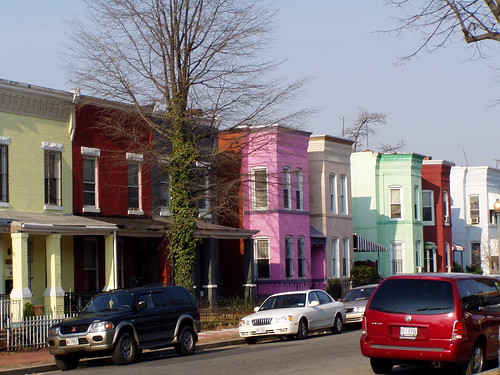
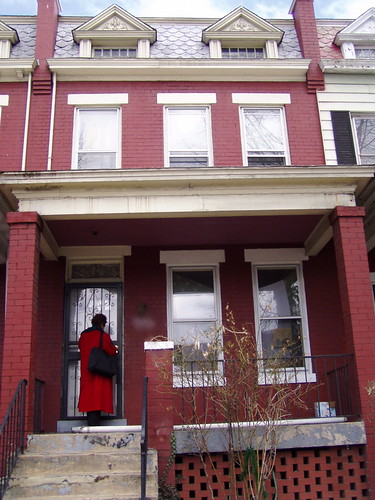
On the blog-a-front, I was excited to discover inked, a blogger who lives in Trinidad. She writes at Frozen Tropics (Trinidad in a D.C. winter?), where the July posts are a frantic recap of hourly updates on shootings, checkpoints, and homicides. Digging through her archives, I found a great post on Trinidad houses that shows how picturesque much of the neighborhood really is. She is also a studious chronicler of the revival of the H Street corridor, still reeling forty years after the '68 riots. Her sense of both neighborhood pride and civic engagement is heartening, to say the least, and has already mitigated much of the hysteria that seeped through the media coverage of events in the neighborhood over the last couple months, which makes it all too easy for someone who has never visited the neighborhood to write it off on news coverage alone.

Enjoy your beautiful rowhouse, inked, and be safe.

Labels: , , ,

Thursday, May 29, 2008

I'm So Bad, I Party in Detroit


For many, a city like Paris or London or Rome seems unreal -- how could the real thing possibly compare to the endless images and leitmotifs in books and movies? For me, that city is Detroit. Does it really exist? Does anyone live there at all? Hasn't the whole thing been abandoned by now?

There doesn't appear to be an online version of Jerry Herron's "I'm So Bad, I Party in Detroit," although there is one of "Everyday Survival." The two together gave me my impression of Detroit: devil's night arsonists burning the city to the ground, itinerant metal scrappers slowly stripping it apart building by building, and RoboCop fantasizing where it will all end up. I quoted both in an article I penned on shrinking cities. Detroit is the American shrinking city par excellence, the only one to exceed the magic 1 million mark and then dip back below it.

As the sun came up on Sunday morning, I gazed out at glistening, isolated casinos (MGM Grand, The Motor City) from the back patio of the TV Bar, an out of the way watering hole off from downtown hosting an after-after-party for the first night of Movement: Detroit's Electronic Music Festival (hereafter DEMF). I chatted up a couple Detroiters who gave me the apocalyptic facts: a city built for 3 million now housing less than 1. 70,000 vacant houses. "Fucking tumbleweeds man," a guy said, shaking his head.

The emptiness is everywhere, permeating downtown and any neighborhood you might pass through. Coming from the crowded northeast, this kind of vacancy is simply unsettling. Neighborhoods didn't seem "dangerous" in the conventional sense so much as eerily empty. Two blocks off from Hart Plaza, the central downtown festival location, you can easily find high-rises of boarded up windows. "For Sale" and "For Lease" seem to be the most popular phrases in the Detroit signage lexicon.

But amidst all that abandonment, there is some extra elbow room, the kind of space that allows an after-party to run until 6 am and an after-after-party to kick up right after at 7 am, outside, on a Monday morning. Who's going to complain? What neighbors? It's the hollowed out core of the inner city that, unexpectedly enough, has incubated culture. Thus techno, thus Inner City / Good Life, thus the collapse of the auto industry and thus Model 500's Night Drive.


The Renaissance Center hovers over the Renaissance City, as Detroit began calling itself in the 1970s. GM's headquarters shine over the horizon looking like cylinders ready to churn in a V8 engine. The ground floor levels house a shopping mall arrayed around GM's latest models.

But the auto industry is still failing, attendance for the Detroit auto show is still falling, and DEMF keeps soaring.

Another take on the Renaissance City motif by Coleman Young, the city's first black mayor: The renaissance of Detroit is the city being reclaimed by its black residents. The proof is in the fist, ostensibly Joe Louis', but more directly the fist of resistance, of black power, of pushing whites over to the other side of 8 Mile.


I'm still seeing the city's wounds freshly. More thoughts to collect & a promised article to Spannered. My own photos once I can get a new USB cable, a casualty of the weekend's debauchery. But DEMF did not disappoint, and the nexus of local/international/Detroit orbital music was top-notch. If anything will be Detroit's renaissance, techno makes for a leading contender.
__

At least they've got some playoff hopes to keep spirits alive. I call Red Wings taking the Cup in 6 / Pistons going under to the Celts. Detroit's white/black divide continues. It's a cold, cold world.

Labels: , , , , , ,

Thursday, August 02, 2007

Invasion


Fairly full days running around Rio have somehow let updates fall by the wayside, but today was too much to pass up: What had been feared since before the Pan-American Games finally occurred. Today, the police invaded Rocinha.

I awoke to the sound of firecrackers and helicopters. The former are a typical warning signal–the police are coming–while the whirlybird overhead left no doubt that the police had their eye on Cachopa. I exited the door of my apartment to head upstairs and inquire with my host family about the situation. As I climbed the stairs, I looked out onto the Rua da Raia, where a squad of 6 or 8 polícia militar (not what we think of as "military police" that guard military bases, but rather police with military training) was conducting house-to-house searches. They made it to our place, demanded that we open the front door, and proceeded to search upstairs, but did not come into the apartment I share with the other Two Brothers volunteers.

Later, still hoping to leave Rocinha for the day, I stepped out again. One of the police, who must've heard about me from upstairs, asked about my roommate and me. When I told him the roommate is from San Francisco, he lit up. "Ahh, já conheço São Francisco três vezes. A Califórnia é muito bonita." So, I can go? "Sim, sim, tudo tranquilo aqui."

Down on the Estrada da Gávea, business seemed to look roughly as usual. As I neared the bottom, I saw another squad of police with binoculars and sniper rifles, peering up into the Vila Verde area, trying to get a bead who knows what or whom.

Simply put, these were military tactics. The notion that Rio is a city at war, while easy to discuss in the abstract or via the media, has never been clearer.
___

Of course, my first-hand experience of the event pales in comparison to its media coverage. Down in Leblon not too long after, I mentioned to somebody that I had just come from Rocinha, where it was "muito quente," and I wasn't talking about the weather. The person already knew, having seen live TV reports. It was on the nightly news, the mental confusion of seeing streets I know, streets I had just walked, that 12 hours before were under police lock down. They were back under ADA authority, bocas-de-fumo in full swing, by nightfall.

I was going to wait until the papers came out tomorrow, but curiosity killed the blogger, and so the Globo article linked to above probably gives the standard account. I say standard rather than accurate, because reporters generally follow the police line. They aren't trusted by the favelas, especially after 2002's Tim Lopes disaster, and now seem to prefer a variation on the embedded reporter routine.

The 6-hour "mega-operation", according to the article, consisted of entering Rocinha from all its principle access points simultaneously and generally rounding up suspected traffickers, seizing arms & drugs, and going after one particular location of guns & munitions, which turned out to be empty. A few individuals were arrested, including a certain "Betinho da Cachopa," who I don't know, but who I suspect may have been busted by my San Francisco-loving uninvited house guest.

Of particular interest is the high-tech aspect: logistical support via a laptop with satellite imagery, abetted by the helicopter's bird's eye view. The police, in so many ways, were attempting to penetrate Rocinha, to control it in 3-D space, on the ground and from the air. But I suspect that satellites and helicopters aside, the dense layer of becos still proves to be a strong defense, many having run for the alleys as soon as the firecrackers started up. The Estrada da Gávea is easy to control–it itself is a kind of asfalto space, running city bus lines like any normal street–but the deeper into the becos, the deeper into the favela architecture, the harder their tactical manoeuvres become. The structure itself is a kind of self-defense, as I've maintained for some time.

The same concern has also made it to the U.S. military, where the urban slum/shantytown is seen as the key battleground of the 21st century. A choice quote: "'Rapid urbanization in developing countries,' writes Captain Troy Thomas in the spring 2002 issue [of Aerospace Power Journal], "results in a battlespace environment that is decreasingly knowable since it is increasingly unplanned.'" From Captain Thomas's perspective, this represents a threat. From my perspective, this represents Rocinha's most fascinating innovation. An unknowable space, it still remains closed to me in many ways.
__

I give the Globo article credit for at least paying lip service to the effect of the operation on Rocinha, mentioning the numerous schools closed and commercial strips shuttered. Two Brothers canceled classes tonight, even though firecrackers hadn't gone off since almost noon.

But as Rocinha settled down, I began to wonder, what does such an operation accomplish? Sure, they seized a small quantity of drugs and guns, but there are plenty more when those came from. A temporary incursion, temporary establishment of official authority over the illegal space. A continuation of promises from pre-Pan to take back the favelas. There nonetheless seems to be a Sisyphean aspect to it all, rolling an armored car up a hill, only to see it tumble back down a few hours later. While I was seized by a mild terror, especially when the police came for my house (suddenly I'm the enemy), it seemed to be greeted with a kind of wearied resignation elsewhere. The cycle continues, ad nauseum. Dona Josirene showed me bullet holes in the wall at the end of our alley on my way out after the coast was clear.

Labels: , , , ,

Sunday, July 22, 2007

Taking Sides: A Hot Night in Rocinha

The day began well. I spent the morning and early afternoon at São Conrado beach – on the other side of São Conrado, the neighborhood of condos and the Fashion Mall across the highway from Rocinha – which is always a scene on Sundays. It seems that all of Rocinha is out: surfing & sunbathing, playing futebol & volei (or their dexterous child: futevol). It might as well be the Praia da Rocinha, although I'm sure the residents of SC whose property values depend on that beachfront cachet wouldn't approve of the name change. A few hours in the sun were followed by a rare treat: Sunday feijoada care of my Bahian neighbor, Almir.

That left me wanting only a light dinner, which I followed with a stroll down the Estrada da Gávea, Rocinha's main drag, in hopes of using a pay phone to make some calls back to the States. After striking out with occupied or broken phones, I finally was at the end of the Estrada. Having still less luck (it's complicated, but Brazilian phones don't seem to like the idea of me inputting the 12 digits of an account number and PIN after making a toll free call to my international calling provider), I was about to turn around and head back, when fortuitously my girlfriend called my cell phone. It's exceptionally windy tonight, along with the usual noisy pace of traffic at the bottom of the hill, so I had trouble hearing her. I wandered over toward a cluster of buildings – a grocery store, pharmacy, a few condos – running parallel to the highway but set at ground level, and ducked next to a garage door where there was some cover from the wind.

Not 5 minutes into my call, a police car drove by and stopped. Two policemen came toward me, one hanging back with his assault rifle, the other approaching me directly with a flashlight. He asked me what I was doing and I told him talking on the phone, out of the wind and the noise. This answer was less than satisfactory and he began to search me while asking me where I lived. "Rocinha," I answered. "Estou fazendo um trabalho social (I'm doing volunteer work)." He gave me a full pat down, lifted my shirt, pulled the waistband of my shorts & underwear outward then shined his flashlight down into my crotch, and then proceeded to scan the ground all around, looking for whatever drugs he was convinced I was in possession of.

All I had on me were my keys and my phone, not having expected to go very far. I didn't even bring a wallet, much less ID or a copy of my passport/visa, which I've been in the habit of doing. Finally satisfied, his partner said I could start talking on the phone again while the first cop kept searching the ground with his flashlight.

What set them off, I wondered on my way back up the hill. I had on a Fluminense jersey, athletic shorts, and Havaianas, all standard issue Brazilian clothing. But with my light skin and my wristwatch, maybe that pegged me as a rich kid from a nearby neighborhood who'd come into Rocinha to buy drugs? It's a common enough occurrence – drugs, especially marijuana and cocaine, are cheap & plentiful in the favelas, and while favela residents are customers, they're certainly not the only customers. Common enough, too, for there to be police: they're at the bottom of the morro everyday. There are even police posts set up inside Rocinha along the Estrada da Gávea. Talk about penetrating deep into enemy territory . . . But they're all paid off, I've been told, and don't give Rocinha any trouble. I've seen bandidos with visible guns ride right by a police post on a motorcycle without a second glance.

On the one hand, it confirms all of my suspicions and prior knowledge about Brazilian police, how essentially in a country that's only 20 years out of a military dictatorship, civil liberties are far from guaranteed and the cops are not to be trusted. On the other hand, couldn't an analogous situation be drawn to any major U.S. city? If I were in a lower-income neighborhood near a known location where drugs are sold, and fit a certain police profile (like, say, black), and happened to be standing alone in a secluded corner on a side street at night when cops drove by, wouldn't they stop?

It's ironic coming on the heels of my thoughts on guns in Rocinha, because I did imply a certain lack of anxiety around gun-wielding police officers, who can be seen in the ritziest, most tourist-friendly parts of Rio with heavy-duty arms. While I didn't think at any point I was going to be shot, I entertained the thought of having something planted on me or getting hauled away on some kind of made-up charge, both practices I have heard rumors of. Indeed, the only "incident" of any kind I had last summer was with MC Gringo, when we were exiting the Baile de Cantagalo and heading into Copacabana. Right as we descended the stairs, a police car pulled up and just about gave Gringo and I the same once over that I got tonight. They seemed to be after bigger fish up on the hill and let us go, but afterwards Gringo told me that had we been searched, having something planted on us would not have been unheard of.

So I climbed back up the hill. It's a hot night in Rio, the first day that the heat has really soaked through day & night since I've been here. I regretted wearing a shirt on the walk back up, passed by crowds glistening with sweat at the door of Clube Emoções, their Sunday night baile funk in full swing. The wind whipping debris around the Curve do S, both an S-curve along the Estrada da Gávea and the área around it (Pipo's Locomotiva threw a massive baile at the bus garage there last night, still raging when I got home at 5 am, making the room vibrate at the right frequencies). Normally I take the becos home – stairs being easier to manage than the 30º incline up the hill into Cachopa, cresting the boca-de-fumo at the quadra de futebol and heading down to Seu Jose's house. But I was determined to walk right past the bandidos just to prove a point: that they wouldn't hassle me while the police would. Other than some bemused questioning when I arrived, loaded with luggage, no one's ever given me a second glance there.

Tonight was no different at the boca-de-fumo, but it was a new scene down on the Estrada da Gávea. Maybe the winds are getting to everyone, Santa Ana style, or there are just rumors about that I don't know of. As I rounded the Curve do S, a man lurked on the sidewalk, a large weapon positioned on his shoulder. I thought RPG at first, but it appeared to be an assault rifle with silencer. He was aiming it at cars coming up the Estrada. I crossed to the other side of the street to avoid walking in front of him. Over there, two of his comrades were also camped out, albeit without aiming. The swirl of humanity kept pace around them, barely noticing on their way up & down. Buses and vans lumbered up the road while motorcycles darted between them. Young girls in teased hair and tight outfits teetered down the steep grade toward Emoções on high heels. A group of hardened men didn't bat an eyelash as they sat at a sidewalk bar drinking cervejas and playing cards.

I walked up into Cachopa shaking my head. A hot night in Rocinha.

Labels: , , , ,

Kids With Guns

Update: I accidentally posted Cidinha e Doca's proibidão version of "Rap das Armas", even though they credit Junior and Leonardo as the authors. Thanks to DJ Zezinho for correcting me.


Before I got an Internet connection installed here in the house, I went up the street to a LAN House, as they're called, to take care of my digital business. I brought my laptop, so all I needed was to hook up a cat-5. Lucky, too, because all of the terminals with a full rig were constantly occupied. I'm not sure I ever saw a free computer in that place.

Most of the customers were kids, under the age of 16, if I had to guess, and they were almost always playing first-person shooters. It's a genre of computer game to which I can profess considerable familiarity, having passed more hours than I'd like to admit blowing my friends to pieces. I was always firmly against the argument that violent games inculcate violence – if you're maladjusted enough to let a game cause violent mood swings, perhaps you've got deeper problems than what you're playing on your PC. And in the case of Grand Theft Auto, everyone's favorite target, I think critics focus on the possibilities permitted by the game mechanics but miss the brilliant social satire, especially evident in the in-game radio. Not that it didn't hit too close to home in some places (note that it was also banned in Brazil, not that it's stopped some of the video game parlors I've seen in Rocinha, who might appreciate the tragicomic aptness of this parody).

On the whole though, such games are simply difficult to take seriously when you have a BFG9000 at your disposal. In the case of my suburban friends and I, such games were the closest we ever came to any weapons, whether they be the absurdity of Doom or the realism of Counter-Strike.

In the case of Rocinha, it's more or less the opposite. The public presence of guns has been a part of every young resident's life since birth, and likely they saw them in person before they ever held one virtually in a game. Certainly, the same goes for those in the asfalto, as the police pack plenty of firepower as well. But the concept of "police" still comes with a kind of separation from the average citizen (on-duty, off-duty). Not that my corner bandidos aren't uniquely different from Seu Jose and his family upstairs – they most certainly are – but it's a kind of 24/7 role. They don't seem to become "civilians" the way a police officer might at the end of the day. Indeed, that's part of how Amigos de Amigos (or ADA, the criminal faction that rules Rocinha) maintains its control, by remaining visible in the community and, as Paul Sneed has explained, firing magazines upon magazines into the air . . . in celebration, in mourning, in reminding you they're still on top.

So it happens, then, that I'm checking my e-mail in the LAN House with young kids on my left and right ripping through virtual decaying urban landscapes, blasting each other with assault rifles, only to have one of the traficantes working the nearby boca-de-fumo ("mouth of smoke", where drugs are sold, and hence the reason I always have bandidos on my block) walk in to watch the Mexico x Argentina match of the Copa América while idly holding an assault rifle. The leap from virtual to real was only a few feet away from every gamer in there.

Are Rocinha kids who play violent video and computer games more likely to join up with the ADA when they grow older? Sounds like a sociological study for another time, another place, another person. But suffice to say: life imitating art imitating life in a very disconcerting way.

Maybe I'm just the still-sensitive gringo who's not used to seeing high-caliber weapons on a daily basis. It's been a fact of life here for decades at least, cf the lyrics of Junior e Leonardo's "Rap das Armas". The closest I could find to the original is the cover by Monobloco, which only changes a few words; and even if you don't know Portuguese, there's some universal shorthand in there, M-16 anyone? Famous in its time, the track that was completely misinterpreted by the media: Junior e Leonardo were tagged as apologists for the criminal factions because they sang the phrase "paz, justiça, e liberdade (peace, justice, and liberty)", the supposed slogan of the Comando Vermelho, when they themselves had no clue that was the case (anecdote recounted in Paul's thesis). It was really just a rap about their quotidian lives . . . which happens to include an extensive catalogue of weaponry.

With an old school Volt Mix beat along with "Planet Rock" and "Push It" samples, it's a veritable classic of funk antigo. The live music video is also extremely dated, but in the best possible way. I've heard they live in Rocinha and someone at I2I knows them, so I may have to pay a visit.

Junior e Leonardo - Rap das Armas

Labels: , , , , ,